Showing posts with label Roleplaying Game. Show all posts

Thursday, June 9, 2022

Enemies Unknown - A Warhammer Fantasy Roleplay: Old World Bestiary review


The art of Warhammer Fantasy Roleplay: Old World Bestiary, depicting a red robed Bright Wizard and an orange mohawk-d Dwarf slayer,  a bare flesh berserker, facing a monstrous horned reptile that takes up most of the background.

Warhammer Fantasy Roleplay: Old World Bestiary

Published by Cubicle 7 (Black Industries 2005)

Design and Writing by T.S. Luikart and Ian Sturrock

Development and Rules Design by Chris Pramas 

Warhammer Fantasy Roleplay 2nd edition's bestiary appropriately reflects the spirit of the game: familiar tropes from a murkier perspective. Patching up the core rulebook's lackluster adversary section, Old World Bestiary provides rules for most of the vicious and strange creatures that populate the tabletop wargame. 

A four horned, goat-headed, one-eyed beastman clad in skulls and makeshift armor.
Cubicle 7

In many ways it's a standard take on one of the classic RPG staples but the book is set apart by its framing. Divided between a player and game master section, the former is presented through an in-universe document, Perilous Beasts. An assortment of rumors and scholarly debate, with a healthy dose of ravings and hearsay, it collects what characters in the setting know about the beings inhabiting dark corners of the world.

Even the more authoritative sections are shrouded by uncertainty, with a letter at the end calling the entire work into question. 

It's a brilliant literary device and one that fits the lopsided, "Ratcatcher" tone of WFRP perfectly. Information that would be common knowledge to most players is often unclear at best to

Wednesday, February 9, 2022

Convergence - A Warhammer Fantasy Role Play: A Rough Night at the Three Feathers Review


The title card of "A Rough Night at the Three Feathers," with an inn sign depicting the establishment name and three parallel feather emblem worked into it.
Cubicle 7

The tavern is such a staple of fantasy roleplaying games that starting a campaign in one is a cliche at this point. But well before that introduction outstayed its welcome, published material for Warhammer Fantasy Roleplay 1st edition featured inns and taverns prominently. It makes sense, considering WFRP has always been standard fantasy at its core, though the gothic and British punk influences - with a healthy dose of dark humor - distinguished it immediately.

A Rought Night at the Three Feathers covers all those bases, a Graeme Davis penned, seven page adventure published in White Dwarf issue 94 and later reprinted in Apocrypha Now and The Restless Dead. Broadly there are some similarities to Jim Bambra's Night of Blood, even down to the naming conventions. Sharing the same basic premise, the module saw the adventurers retiring for the night only to get far more than they bargained for.

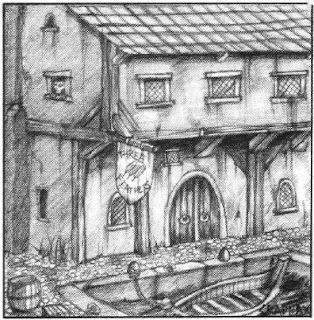
Exterior shot of a dingy, medieval fantasy flavored timbered inn with a three freathers sign near the door. A rowboat is tied up outsied it.
Cubicle 7
Night of Blood might have been relatively complex for its short length but A Rough Night at the Three Feathers is far more experimental, by Davis' own description. Though no mutants are on the characters' trail this time, the adventurers end up embroiled in a murder mystery, a noble's entourage, another visitor's extramarital affair, and of course, a Chaos cult.

Now where did my coin pouch go...

The scenario sports seven plotlines unfolding over the course of a single night, most with multiple personalities involved. A few can play out fully devoid of player involvement or the motives are left unknown to the players. 

Experimental is certainly the word for Rough Night, which more than lives up to its name with such a short page count and time frame. On its face it seems daunting to run. Admittedly I had to read it over four or five times before running it myself.

Despite what one might think, the short length is why this scenario works at all. Seven plotlines is a lot to keep track of, in part because they intersect so much. Rough Night even recommends dropping a few if needed. A longer page count would require too much back and forth,

Wednesday, January 5, 2022

Floor It - A Star Wars: Starships and Speeders Review


The black and yellow cover of Star Wars: Starships & Speeders. The bottom third shows the ragtag rebel feet clashing with H shaped TIE Fighters around the skeletal, under construction body of the second death star. The forest moon of Endor is below this battle.
Edge/Lucasfilm

Released two months into 2020, the compilation book Starships and Speeders is currently the last supplement published for Fantasy Flight Games' Star Wars roleplaying game system, which includes Edge of the Empire and Age of Rebellion. It's at least the last one FFG will publish, as Edge Studios now has the license, while fans await further reprints and hold out hope for new books.

In the mean time, we're left with Starships and Speeders. It's more or less what's on the tin: a collection of vehicle profiles for Game Masters to deploy and players to purchase in their games. For the most part, it collects existing stat blocks, though a few new additions have been made, mainly vehicles that showed up in Solo

It's an exhaustive selection, including nearly every ship from FFG's X-Wing wargame and a few new ones, like a luxury cruise liner. It's a decent mix of military and civilian vehicles, along with the vessels used by less savory elements. I would have liked some more Legends additions but I understand the further we get into the Disney era, the less likely that is. Starships and Speeders does leave a few nods here and there, like a reference to the Droids cartoon in the A-Wing background.

High above red clouds amid a yellow sky, the weathered, misshapen dome of the Millennium Falcon flees the pursuit of a TIE Fighter squadron
Edge Studios/Lucasfilm

Starships and Speeders isn't entirely a copy/paste job though, as iconic ships are given unique profiles. For example, there's the YT-1300 entry and then one specifically for the Millennium Falcon.

Thursday, November 18, 2021

Grimdark Reloaded - A Warhammer Fantasy Roleplay 2nd Edition Review


The Cover of WFRP 2nd edition. A group of hardened adventurers, led by a Dwarf Slayer with an orange mohawk are surrounded by Beastmen. Staked skeletons blot the murky skyline.
Cubicle 7

Developed by Green Ronin Publishing and published in 2005 by the short lived Black Industries, Warhammer Fantasy Roleplay 2nd Edition revived a grimdark classic. As far as second editions go, it's hard to beat. More than a simple clean up, the designers incorporated 19 years worth of improvements while making a game that was still recognizably WFRP

It's a familiar story, with humble adventurers, including the likes of rat catchers, woodsmen, and scribes, facing off against the horrors of a fantasy world threatened by the Dark Gods of Chaos. But even vicious adversaries like Orcs, Goblins, ratmen, daemons, and worse, often pale in comparison to plain old human cruelty and injustice.

Like its predecessor, WFRP 2E combines straightforward rules with a heavy atmosphere, defined by hard fought victories and often short lived characters.

Even with a successful 4th edition, WFRP 2E is still the go-to for those looking to explore the Old World. Personally, I don't think it's the automatic improvement over 1E many see it as. But I can't deny it's a strong game that kept the light burning for this grim world of perilous adventure.

All Too Familiar

It's easy to see 2E as mostly being a streamlined update of the original system. The core rulebook is only around 250 pages, compared to 1E's mighty tome, but both books offer a comparable amount of content. Most importantly, the career system is almost entirely intact and still takes up a big chunk of the page count.

A huge part of 1E's appeal was that the players were taking control of normal people in an unusual world. Even if Warhammer's fantasy tropes were very familiar, drawn from the pillars of the genre and real world history, WFRP stood out by exploring it with more relatable, mundane characters. 

An example career profile, depicting the mighty Rat Catcher, with a dead rodent covered back banner declaring him to be a "Rat Killer" as he leads his small but vicious dog forward.
Cubicle 7
Once again, players have to randomly generate their career from a list of dozens. The roster is largely the same, though more species specific options have been added for Elf, Dwarf, and Halfling players. A few have been modified or removed entirely. Bawd and labourer are missing in action, though I'm hardly sad to see the back of the tasteless "Slave Trader" advanced career. Beggar has been recast as the more scavenger like "Bone Picker." Torturer has been laughably sanitized into "Interrogator," without any changes to the actual career.

Through hard work, quick thinking, and dumb luck, players can see their adventurers end up as the likes of knights, Slayers, and other influential figures.

Wednesday, October 20, 2021

Halloween Tips for Running a Horror RPG


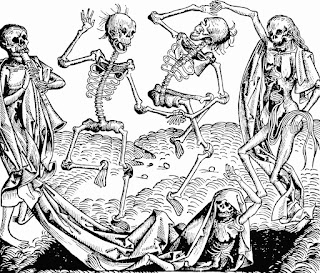
Michael Wolgemut's "The Dance of Death," depicting 4 reveling skeletons, 3 dancing and one playing a horn, as another of their number rises from an open grave, the horn blower using their death shroud as a garment.
Nuremberg Chronicle

A notion I see thrown around a lot is that roleplaying games just can't be scary. I used to think that myself. The logic is similar to the one applied to Co-op video games: it's too hard to be scared when you're goofing off with your friends. In hindsight, I think that spoke more to the games I was running and the systems I was playing.

Not only are there a host of RPG systems designed with horror specifically in mind, most notably Call of Cthulhu, I've found that this medium is in a unique position to embrace horror. After all, no other art form gives the audience the level of agency a roleplaying game does. Even video games are constrained by code and technical limitations, whereas the only limits of an RPG are those imposed by the table.

And that can allow for a damn scary story.


The Right Tools for the Job

Contrary to what you might expect, I don't think you necessarily need a horror system to run a good horror game. It certainly helps and that's where you should look first. But other systems can be used to bring the genre to your table, if you keep in mind what makes dedicated horror rulesets tick. My most successful horror game (which managed to give one of my players nightmares) was run in Star Wars: Age of Rebellion of all things. 
 
Drawing from the undmade Yuuzhan Vong Clone Wars episode and an enduring obsession with The X-Files, I had two Rebel PCs uncover an apparent conspiracy between the Rebel Alliance and an otherworldly, truly alien threat.

Or maybe it was all a plot by Imperial Intelligence to trick them into revealing military secrets.

Tuesday, September 28, 2021

Dark Times - A Star Wars: Collapse of the Republic Review


The cover of Star Wars: Collapse of the Republic with newly inducted Sith Lord Anakin Skywalker, in dark robes with a lightsaber drawn.
Fantasy Flight Games/Lucasfilm

Star Wars: Collapse of the Republic

Fantasy Flight Games

Developed by Tim Cox with John Dunn, Lisa Farrel, Sterling Hershey, Keith Kappel, Monte Lin, and Jason Marker

Along with the three "Essential Collection" books, Collapse of the Republic was Fantasy Flight Games parting contribution to their Star Wars roleplaying game line. Intended as a companion to their previous Clone Wars sourcebook Rise of the Separatists, this book covers the latter half of the conflict as well as some of its stranger corners. The team does an excellent job justifying the decision to split the content into two separate books. Rise gives players what they need for adventure serial influenced heroics while Collapse offers a chance to live out the darkest moments of Star Wars history.

Player characters will need every advantage to survive these bleak, final days of the Old Republic, assuming they're willing to pay the toll taken to their health, finances, and very soul.

New Faces of War

While technically a separate supplement from the first Clone Wars book, Collapse still works best as a companion to it. Whereas Rise covers all the basic careers, gear, and NPCs, Collapse takes advantage of that previous work to introduce more unique and "veteran" options. 

2 new Jedi careers are offered, both rooted in seniority and experience; the very much Yoda influenced Master tree and the more martial General path, with talents that flirt with the Dark Side. The talent "Short Path to Power" is also introduced to resolve an oversight in Rise where players were locked out of building Jedi Knight's at character creation due to the Force Rank 2 restriction.

The focus on more experienced characters is also evident in the three new Clone careers: Veteran, ARC Trooper, and Clone Commander. To top it all off, Collapse introduces "Signature" abilities for Jedi and Clones.

A silver armored Death Watch Mandalorian in flight, fully armored with pistols drawn
Fantasy Flight Games/Lucasfilm

This book also provides more universal specializations, depicting some fan favorite and very specific roles. Mandalorians finally get a proper statline with Death Watch Warrior, sporting talents that make jetpack characters even more imposing but some emphasis on the more social side of the Mando'ade as well.

Which is to say, talents to enhance Coercion.

Nightsisters also emerge from the shadows, offering one of the more genuinely unique and mystical force user talent trees. The first (and only) true Separatist specialization arrives with Separatist Commander, easing the pass for some less explored perspectives. 

Collapse does run into a lot of very "similar" careers. You can make a thematic argument for the clone specializations being so similar but it's still notable how close

Wednesday, July 28, 2021

Bending the Rules - An Avatar Legends: The RPG Quickstart Review


The cover of Avatar: Legends. The avatar is at the center, the symbol of all four elements behind them. The left side is bald air nomad Aang and the left is water tribe sports star Korra. Their eyes glow with the shared power of the Avatar state.
Magpie Games

Avatar Legends: The RPG Quickstart

Designed by Brendan Conway, James Mendez Hodes, Marissa Kelly, Mark Diaz Truman, Miguel Ángel Espinoza, Sharang Biswas, Elizabeth Chaipraditkul, Yeonsoo Julian Kim, Daniel Kwan, and Sen-Foong Lim 

Published by Magpie Games 

When it comes to licensed RPGs, there's been a gaping, Avatar the Last Airbender shaped hole. The hit animated TV show follows Aang, the titular Avatar and reincarnating master of four elements, and his journey to bring peace to a world at war. The spectacle of element bending, along with the episodic format and strong character development, makes it ripe for a tabletop adaptation. 

Thankfully the wait will soon be over, because Magpie Games has announced Avatar Legends: The RPG. The company that published the critically acclaimed MASKS and Bluebeard's Bride, they recently released the free quickstart rules as a preview. It's a strong offering and shows a promising future for the game.

Like previous Magpie Games' publications, it uses the divisive Powered by the Apocalypse ruleset. I haven't had experience with it until now, but from what I've seen, many people refuse to play anything but and there's another vocal subset that want nothing to do with it.

Aang and his friends Katara, Sokka, and Momo hanging on tot the saddle of the Air Bison Appa for dear life as he makes a sharp turn near a mountain top.
Magpie Games
Going off of Avatar Legends, it's very much a storytelling driven approach to RPGs, and the experience is dependent on the group running it. There's not much to keep track of but it does take some getting used to how everything fits together.

Resolution is done with 2d6, with the relevant modifiers from your four Stats and other conditional factors. The Stats are in line with how we see the characters of Avatar solve their problems, consisting of Creativity, Focus, Harmony, and Passion. Rolling 1 to 6 is a failure, 7 to 9 is a "soft" hit, and 10+ is a full hit; a success and then some.

The game rarely gets more complicated than that, though there are two very interesting aspects that stick out to me. A character's negative emotional state is represented mechanically with one of five Conditions, such as Angry and Foolish. These make certain actions more difficult and require the player to act on those emotions to clear it. Rather appropriately for Avatar, the injury system also uses Conditions.

In combat, players aim to inflict Conditions without getting countered. Once a character ticks all five boxes, they're out of action. It fits the sort of stories told in this setting very well. Defeating a foe is just as much about emotionally overwhelming them as physically besting them.

In line with that, the core mechanic of the game is Balance. Players have two conflicting Principles. When they act towards a given Principle, it moves towards that and away from the other. Going too far on either end causes players to "lose Balance" and flee from a situation. Besides their own actions, players and NPCs alike can make rolls to tip another character's balance. Characters that manage to keep both their Principles in check can make unique actions after Advancing.

It's a brilliant mechanic, one that really captures not just the surface level aspects of Avatar but also its deeper themes.

The game as a whole does a good job with that, at least going off this preview. Magpie opting against dedicated rules for bending shows how they're approaching this. It's a galling prospect to make an Avatar game without its namesake abilities. In game, Bending is left largely cosmetic, though in such a light system being able to manipulate earth, air, wind, or fire certainly has some creative applications.

Korra, Bolin, and Mako in sports bending gear, using their respective elements: Water, Earth, and Fire. The audience and pitch fills the background.
Magpie Games
The lack of bending mechanics has already caused a lot of noise in RPG circles and Magpie felt the need to add a sidebar rationalizing the decision. Though I was taken aback at first, I ultimately agree with the decision after actually playing the game. 

The spectacle of bending is what drew most of us into Avatar but its philosophical and narrative foundation is what really made the show work. Having a D&D or Pathfinder spell style system bending would have frankly been miserable and they were right to put their efforts elsewhere.

Character Creation does seems short in options but rich in meaningful choices. Characters have a choice of six "Playbooks," blocks of stats and unique techniques that reflect each of the main Avatar cast's character archetypes. It's a good way to guide player's towards the kind of stories that make the show so memorable. While I think the way personality ties into each playstyle is interesting, I do wonder if it would box in how players can approach their characters.

Luckily, players have to come up with personal histories, specific goals, and connections with other player characters. This helps avoid the limitations that might come from the archetypical approach by ensuring every playbook has a different narrative approach, even if the broad traits and mechanics are set.

Players do have considerable agency in Avatar: Legends, despite certain limitations in character creations. Non-combat and combat moves are a small roster described in broad terms, once again with the main focus of adding or removing Conditions and altering Balance. The system encourages players and GMs to frame their rolls as developments in the narrative, rather than just actions or skill checks.

Avatar: Legends also gives players a lot of say in the actual premise of a campaign. The players and GM discuss the scope, era, focus, and even inciting incident of the campaign before it begins. It's a very communal effort and the game master section positions more as a player with unique responsibilities than some kind of overlord.

Aang propels himself at a ball of air past a statue of a beast with its mouth open in a mountainous setting. Sokka looks doubtful.
Magpie Games

Half the quickstart rules page count is taken up by the pre-written adventure "The Forbidden Scroll." The players are captured on the eve of Fire Lord Ozai's coronation but after being released by a defector, they must now escape the city before they are caught once more. It's a straightforward scenario with a range of options, many tailored to the pregenerated characters' backgrounds. It can be as quick or as drawn out as the table wants it to be, with a surprising amount of replayability.

Overall, it's a versatile little story with a few unique mechanics, like the clock tracking the festival events and the guards progress. If the rest of Magpie's Avatar output is on par with this, it's a very good sign.

The presentation of the quickstart rules is decent enough, though it's rife with misspellings. The rules, particularly Combat, are framed in a way that makes them seem more complicated than they actually are. Art wise, there's some great sheets for the actual game portions but the art consists of what looks like recycled promotional assets. And not very good ones at that.

There's still plenty left to explore in the final release, namely a proper NPC section, but Avatar Legends is a surprisingly complete publication, with an easy to learn system that authentically captures the setting.

Tuesday, May 25, 2021

Collector First Impressions

Ideal Hands Games

 Collector

Ideal Hands Games

By Greg Farrell, Joe N Brown, and Danny Kostianos

Special thanks for the advance copy


Little is certain in the shadowy Realm, except that death is fast approaching. When the time comes, those who want a tolerable afterlife must pay 1500 gold coins to the goddess Ubato. Anyone who falls short is trapped in limbo, forced to watch others make a journey forbidden to them. With a world teetering on the brink and a life days away from ending, the Roller sets out to pay the toll the only way they know how. Dice games.

They'll roll off against a range of opponents, each one stranger and more disturbing than the last. Greatest of perhaps all adversaries is their collector, who lent them money to get the Roller back on their feet and now intend to collect. The game itself is simple enough but when you lose it all, that includes your immortal soul. You can cash out of a match with your winnings in tow but the call of the game means you'll be back eventually.

Collector is a micro-RPG by Ideal Hands Games, currently on Kickstarter. Clocking in at just under 30 pages, it's designed for one player and one game master. There's also rules for a solo play and multi-roller mode, though the game works best with two souls dueling with dice for a peaceful repose. It's an agile game, with a strong central idea and a stronger central mechanic. 

Ideal Hands Games

There isn't a huge amount beyond that but Collector covers all the ground it wants to. Collector is a simple enough game, one that captures a lot of the current zeitgeist in dark speculative RPGs but with a novel twist. There's a few issues in presentation I do hope get worked out by its proper release.

Narratively and mechanically, the lure of the dice is all that's left in Collector. Beyond the apocalypse unfolding in the background, the Player character, or roller, knows they're soon to die. There are plenty of apocalyptic RPGs and such fatalistic affairs are especially popular right now. But I appreciate how Collector bucks the mold a bit in that players have accepted their impending death, all that's left now is to make preparations for their passing. 

It adds a novel twist to the well populated genre of superdark fantasy, a compelling hook that helps set up the dice game mechanics. The setting itself has some personality, especially through the  strange characters inhabiting the various random charts and their secretive gang affiliations.

Monday, December 28, 2020

Space Truckers - A Mothership: Player's Survival Guide Review


The cover of Mothership: A Sci-fi RPG. Scratchily drawn on an empty white background, a dead astronaut cranges back, his chest having gruesomly exploded outwards by unknown means. His ribs now stick outwards like bony fingers, his own intestines pooling in his lap. A device with an antenna is in his right hand.
Tuesday Knight Games (Sean McCoy)
 

Published by Tuesday Knight Games, Mothership: Player's Survival Guide is one of the better roleplaying games to come out of the Old School Renaissance scene. True to its name, OSR tries to channel the almost mythical origins of the medium, when the game master was the uncontested ruler of their domain, balance wasn't on most players' minds, and rules are closer to suggestions. Most of the OSR content has been Dungeons & Dragons inspired, ensuring the sci-fi horror stylings of Mothership stands out even more.

Despite the title, Mothership: Player's Survival Guide gives everything you need to run harrowing tale of space exploration gone awry as a Warden (GM). The few other OSR publications I've looked into are fairly lightweight, both in terms of page count and rules. Even so, I'm still impressed with what Mothership accomplishes in forty four pages. While it's not the polished, high production value output of major corporations, Mothership has a distinct vision that's competently realized, putting it above most high budget mainstream publications.

In a grey and blue tones is a woman in a white t shirt, with workers pants and a bandolier. She doesn't look thrilled.
Tuesday Knight Games (Sean McCoy)

Part of what gives the game such a coherent identity is how it was mostly done by a single person, Sean McCoy. In addition to doing the bulk of the writing, he also provides the dark illustrations throughout the book. Even other indie titles rarely opt for such raw, unrefined art. At least, if they do, it usually doesn't turn out this well. 

The most visually impressive pieces in the book have visible brush strokes, with a handful being nothing more than almost childish scribbles. That's not a criticism, as these monochrome, dark blue-and-white depictions of hard bitten space travelers and their nightmarish adversaries puts you in the right mood.

Mothership strayed from the norm with such a unique visual style, ensuring that it's one of the more memorable RPGs I've picked up. I wish more games would take the risk of such a nonconventional art style, especially as the medium seems to get more and more homogenous.

Fight For Your Life 

Two astronauts fight off gaseous or shadow like creatures. The one in the foreground clutches a futuristic rifle, though their face is obscured by the strange gaseousness filling their helmet. The other struggling astronaut calls for help as one of the featureless creatures ensnares him with tendrils.
Tuesday Knight Games (Sean McCoy)
With Warhamer Fantasy Roleplay 1st Edition as my favorite RPG, I was quick to appreciate Mothership opting for a brutal percentile system. Similar to WFRP, Call of Cthulu, and other investigative D100 powered games, there's a clear effort to keep the rules concise. Rules for character creation take up a single page and even the sheets themselves can be used on their own with the built in flow charts. Admittedly those can take some effort to make sense of but the point stands, Mothership tries not to waste any of its short page count.

By the same merit, players will fail frequently at earlier levels, so Warden are incentivized not to get bogged down in mechanics. Not that there's many to keep track of: players have 4 Stats and 4 Saves, the former category being active and the latter reactive.

Appropriately for a horror game, the Saves are an even split between physical resilience (Armor, Body) and mental fortitude (Sanity and Stress). Depending on how a session goes, players might end up rolling against these more than their stats, as they struggle to survive.

Need To Know Basis

Mothership also employs an appropriately "Old School" skill system. Covering the full gamut of spaceship maintenance, bug stomping, and teknobabble science, it represents bonuses for complex activities. For certain specialized skills, it allows players to even attempt complex procedures. There's a notable lack of social skills available, another deliberate omission. Usually I consider those mechanics a must but such a straightforward ruleset gets a pass. 

A hit location chart showing a flinching, bearded astronaut is shot in multiple places. 6 boxes accompany the corresponding body part, reading "1: R. Leg," "2: L. Leg," "3: R. Arm," "4: L. Arm," "5-9: Torso," and "10: Head."
Tuesday Knight Games (Sean McCoy)
It seems that Wardens are supposed to let conversations play out organically, rather than leave it at the mercy of arbitrary dice rolls. That so much of the game pits players against foes that can't be reasoned with probably has something to do with it.

Combat is a little more detailed but still straightforward. Players get two Significant Actions a turn, which can be attacking, operating machinery, or running away. Conflict is resolved through Opposed checks, with the attacker pitting their Combat stat against their target's Armor save. When you hit 0 Health you roll a Body save or die. NPCs are scaled down to only have Combat and Instinct, the latter a catch all for every other Stat and Save. 

The end result is combat that is as quick and brutal as you would expect from a horror game. There's something to be said for a game where all the combat rules can be easily summarized on the provided cheat sheet.

Keep it Together, Man

Sanity mechanics have been a long time staple of horror RPGs but easily veer into problematic territory. Many (myself included) have argued even the concept of turning mental health into a game mechanic will always be tasteless. I will admit I've decided there might be a place for it, if handled with care.

Luckily that's what Mothership does with its Stress & Panic mechanics, as it preserves the spirit of the sanity check while jettisoning some of the less tasteful elements. Over the course of their ordeals player characters chafe under the strain of their ordeal, represented by Stress. The more Stress you have, the more likely you are to snap when the time comes to test Panic, which is usually when the monster rears its ugly mug or a character takes a critical hit. Panic encompasses a momentary loss of composure, all the way up to a total loss of sanity or a heart attack.

A gaunt astronaut, clutching their seat as grey smoke exits their open mouth and leaves their spherical helmet.
Tuesday Knight Games (Sean McCoy)
While player characters can and will descend into madness, the game doesn't clumsily try to turn real world conditions into game mechanics. The closest they get are permanent Phobias characters pick up from traumatic events like breathing in sentient gas clouds or getting shot out of airlocks.These are small measurses but I'd say they make all the difference.

Work for a Living

Much of the OSR movement is transparent about its influences and Mothership is no exception. The game draws open comparisons to Alien and Firefly as it tells players the four roles available to them; Android, Scientist, Marine, and Teamster. The first three are fairly self explanatory, but the Teamster is the jack of all trades, presented as the archetypical "Ellen Ripley" (Mothership's own words.) The others might fulfill specialized duties but it's usually up to the Teamster to keep the show running.

A grey, sketchy headshot of an astronaut.
Tuesday Knight Games (Sean McCoy)

In line with those inspirations, Mothership is clear about what kind of game it is. It's about surviving alien encounters, vicious brigands, and earning a living. It can be about all of that or none of that, as the game leaves it up to the Warden what the players should be encountering in the great unknown. The tone is set fairly early on with the aforementioned grim art. The sense of humor is also injected through crude, amusing patches and souvenirs players generate to round out their characters. 

That's very much in line with the OSR mindset of a game system being a tool or set of guidelines, rather than an ironclad set of restrictions.

Tools for the Job

In contrast with most of the rules, Mothership offers a substantial gear section. The arsenal is well stocked with the expected sci-fi weapons, like submachine guns and plasma rifles. There's also the expected weaponized industrial tools, like foam and harpoon guns. Tracking ammo is a big component of the game, emphasizing the survival focus. While fiddly, it does add to the atmosphere, leading to one of the more flavorful rules, where anyone lacking the proper skills will empty the entire magazine of a fully automatic weapon in one burst.

There's also a large range of non weapon items, though a good number have a combat role. Armor is an important part of combat in Mothership and some impressive defenses are on offer - at a price. The vast majority of items are related to basic survival in hostile environments. Ubiquitous pain pills and stimpaks are present, though punishing addiction rules discourage their usage.

An array of boxy, grey and blue futuristic rifles and pistols.
Tuesday Knight Games (Sean McCoy)
There are also comparatively in depth rules for the spacecraft player characters will hurtle around the galaxy in. Profiles are provided for a variety of ship types, though you ultimately have to "construct" them. A fairly complicated sheet shows how to distribute a ship's hull points to individual modules (such as engines and life support.) Once that's done, the ship has to be sketched out in a provided grid. I'll admit this is one of the more daunting aspects of running Mothership and could be better explained.

The rules for ship building mostly emphasize the survival side of things: operating cryosleep, distributing food and having enough oxygen. Ships are expensive to run and even more expensive to acquire. Like most sci-fi RPGs, space combat is a scaled up version of ground combat, with a handful of changes. In one of the more surprising pulls, "Megadamage" from the infamous RIFTS makes a showing. One point of ship MDMG translates to 100 points of regular damage. I'll admit it's amusing to see any connection between the two systems, as I don't think they could be further apart otherwise.

Waiting Under Your Bed

Interestingly, the monetary side of things gets more support than the monsters that haunt the margins of Mothership. I'm sure it sounds confusing for a horror game to decline to even provide a list of pregenerated monsters. Even human adversaries get more support through the mercenary and crewmember profiles.

Scratchy black lines form a stretched humanoid white silhouette with four arms and four legs.
Tuesday Knight Games (Sean McCoy)

I wouldn't call it a flaw though. Mothership feels too focused and complete for the lack of monsters to be anything but a deliberate omission. After running a few sessions, I've found that absence ended up making for some of the best adversaries in games I've run. With little support from the game aside from scraps of information, cryptic art, and references to mind destroying infections and gruesome ends, there's no choice besides getting creative. It also encourage the Warden to treat the monsters as an active part of the story, rather than just purely mechanical challenges to be rolled away.

The setting is similarly undefined but much like the monsters I'd call it "open ended" rather than "vague." What the world of Mothership lacks in specifics it makes up for in personality. An image quickly emerges of a future that's solved some technological problems but has plenty of human ones leftover. Sex deprived, dark humored spacefarers hurtle into the unknown with less-than-perfect FTL drives. Even if they survive all the horrors of the stars, there are still bills to pay afterwards.

The Adventure Continues

Despite the foreboding atmosphere and harsh rules, Mothership isn't intended to be used solely for gruesome one shots. A characterful experience system is provided, with certain mechanics, namely the horror steeling Resolve, being dependent on leveling up. 

As brief as the actual book might be, Mothership's rules are meant to support an experience rather than be a complete one all on its own. Ideally that's what any game or really any work of art should do but Mothership pulls it off particularly well. 

A very rough, almost doodle like sketch of an armored, rifle toting warrior. Lenses bulge out from the helmets and the grille forms a sort of leering mouth.
Tuesday Knight Games (Sean McCoy)
A strong idea and competent presentation counts for a lot, as Mothership sidesteps the choice between style and substance and goes for both. It might not give you as much to work with as other games but what it does provide is great motivation for a space road trip, bug hunt, or scientific expedition.

Or maybe a nightmarish fusion between all three, since Mothership leaves that choice up to you.


Wednesday, November 18, 2020

Restore Freedom to the Galaxy - A Star Wars: Age of Rebellion Review

Fantasy Flight Games

Star Wars: Age of Rebellion was Fantasy Flight Games' second RPG set in the galaxy far far away. Released in 2014, it came out almost exactly a year after their first foray, Edge of the Empire. Departing from lovable scoundrels and grim bounty hunters, Age of Rebellion instead focused on the ace pilots and daring revolutionaries that made up the Rebel Alliance. Both games employ the same basic mechanics and proprietary "Narrative Dice." As the name implies, Age of Rebellion allows players to play out the Rebellion's desperate struggle against the Galactic Empire. 

 While both games are built around the same foundations, Age of Rebellion does lack a lot of the freedom and flare offered by Edge of the Empire. Even so, this trench run proves to be a successful one.

Second Verse, Same as the First

 Much like FFG's now defunct Warhammer 40,000 Roleplay, every one of their star wars game lines share the same ruleset. Thankfully they've learned well from those days in the Dark Millennium. Edge of the Empire and Age of Rebellion are truly compatible, in contrast with the constant patching over and quibbling needed to integrate the disparate 40K game lines.

Fantasy Flight Games
The two systems are so similar that entire sections of the core book are almost completely identical, with the occasional reworking to better fit the military context. Consequently, Age of Rebellion takes everything that works from its predecessor. And unfortunately, the few things that didn't.

Injury rules as written are put players out of the fight to soon, while also needlessly limiting the lethality. More frustrating, starship combat is still just as punishing and unsatisfying. Dogfights are such a key part of the Rebellion's identity that it's

Saturday, May 9, 2020

Everyday Heroes and Villains: A Warhammer Fantasy Roleplay 1st Edition Review


Cublicle 7 (John Sibbick)

While Dungeons & Dragons struggled with Satanic Panic driven controversy throughout the 80s, famous British wargaming property Warhammer took a very different approach. Published in 1986 by Games Workshop, Warhammer Fantasy Roleplay invited players to explore "A grim world of perilous adventure." That doesn't even begin to describe the horror and bloodshed the system captures or the all too human adventurers that stands against certain destruction.

WFRP 1st edition was released while the mass combat game Warhammer Fantasy Battle was still in its early years. At that time, it was simply known as Warhammer and much of the game's background, rules, and identity was still in flux. Even three editions by that point, the game was an interesting mix of Roleplaying elements and more contemporary wargaming mechanics. WFRP 1st edition would end up bringing a lot of clarity to Warhammer Fantasy as a whole. Besides the wargame aspect, it also proved to be one of the most atmospheric RPG systems ever published and my all time favorite.

The usual Warhammer tropes are all in force in WFRP. Reality is poised to be destroyed by the extradimensional forces of Chaos, who take the shapes of gods and daemons. Besides the direct threat they pose, their plans have left mortals at each others throats. WFRP frames this conflict in a fantasy setting that's a mixture of real world history, Michael Moorcock's Elric series, Tolkien fantasy, Conan, and the other usual suspects.  

WFRP 1st edition was very much a setting driven game, with most of the background information is restricted to games set in the "Old World," which roughly conforms to Medieval Europe geographically and culturally. While the scope was somewhat limited, what they did cover was well explored both in and out of game.

This might not sound very original but what set WFRP apart from the rest was the presentation of these well worn inspirations. There's a strong punk atmosphere to early Warhammer, as traditional fantasy tropes were placed in a corrupted world that drew inspiration from Thatcher England and Cold War fears. Most importantly, WFRP 1st edition was all about playing the little guy. You didn't make heroes, you made characters who could be heroes.

That distinction makes all the difference in the world.

WFRP 1st edition is a game where no matter how strong or experience a character is, nearly anything can kill them: goblins, wild animals, carriage crashes. Meanwhile, the more supernatural threats and the corrupt institutions that rule over the Old World represent an ever greater danger.

The inherent risk of the setting is reflected in a rule set hellbent on tearing life and limb away from the characters. Most of the mechanics stem from a percentile system. For an action to succeed, a player just needs to roll a d100 die below the relevant characteristic, after difficulty modifiers (+10, -10, so on). Easy to learn, hard to actually pull off, much like the rest of the game.

A Twist of Fate

Cubicle 7 (Tony Ackland)

The way you build characters in WFRP is a major contributor to the overall lethality of the game. It's also my favorite part of this system. As I said before, you're making potential heroes. You start by picking one of the four available races, Human, Wood Elf, Dwarf, and Halfling. They're all what you expect.

I often hear people say Elves are too powerful in WFRP 1st edition. They certainly have some notable advantages compared to the other options but in my experience it doesn't matter much. Frankly any mechanical advantages are nullified by the unforgiving nature of the game and the setting's harsh cultural norms.