Showing posts with label Warhammer Fantasy. Show all posts

Thursday, June 9, 2022

Enemies Unknown - A Warhammer Fantasy Roleplay: Old World Bestiary review


The art of Warhammer Fantasy Roleplay: Old World Bestiary, depicting a red robed Bright Wizard and an orange mohawk-d Dwarf slayer,  a bare flesh berserker, facing a monstrous horned reptile that takes up most of the background.

Warhammer Fantasy Roleplay: Old World Bestiary

Published by Cubicle 7 (Black Industries 2005)

Design and Writing by T.S. Luikart and Ian Sturrock

Development and Rules Design by Chris Pramas 

Warhammer Fantasy Roleplay 2nd edition's bestiary appropriately reflects the spirit of the game: familiar tropes from a murkier perspective. Patching up the core rulebook's lackluster adversary section, Old World Bestiary provides rules for most of the vicious and strange creatures that populate the tabletop wargame. 

A four horned, goat-headed, one-eyed beastman clad in skulls and makeshift armor.
Cubicle 7

In many ways it's a standard take on one of the classic RPG staples but the book is set apart by its framing. Divided between a player and game master section, the former is presented through an in-universe document, Perilous Beasts. An assortment of rumors and scholarly debate, with a healthy dose of ravings and hearsay, it collects what characters in the setting know about the beings inhabiting dark corners of the world.

Even the more authoritative sections are shrouded by uncertainty, with a letter at the end calling the entire work into question. 

It's a brilliant literary device and one that fits the lopsided, "Ratcatcher" tone of WFRP perfectly. Information that would be common knowledge to most players is often unclear at best to

Wednesday, February 9, 2022

Convergence - A Warhammer Fantasy Role Play: A Rough Night at the Three Feathers Review


The title card of "A Rough Night at the Three Feathers," with an inn sign depicting the establishment name and three parallel feather emblem worked into it.
Cubicle 7

The tavern is such a staple of fantasy roleplaying games that starting a campaign in one is a cliche at this point. But well before that introduction outstayed its welcome, published material for Warhammer Fantasy Roleplay 1st edition featured inns and taverns prominently. It makes sense, considering WFRP has always been standard fantasy at its core, though the gothic and British punk influences - with a healthy dose of dark humor - distinguished it immediately.

A Rought Night at the Three Feathers covers all those bases, a Graeme Davis penned, seven page adventure published in White Dwarf issue 94 and later reprinted in Apocrypha Now and The Restless Dead. Broadly there are some similarities to Jim Bambra's Night of Blood, even down to the naming conventions. Sharing the same basic premise, the module saw the adventurers retiring for the night only to get far more than they bargained for.

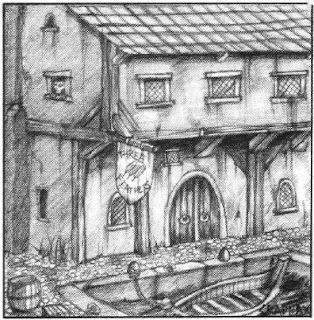
Exterior shot of a dingy, medieval fantasy flavored timbered inn with a three freathers sign near the door. A rowboat is tied up outsied it.
Cubicle 7
Night of Blood might have been relatively complex for its short length but A Rough Night at the Three Feathers is far more experimental, by Davis' own description. Though no mutants are on the characters' trail this time, the adventurers end up embroiled in a murder mystery, a noble's entourage, another visitor's extramarital affair, and of course, a Chaos cult.

Now where did my coin pouch go...

The scenario sports seven plotlines unfolding over the course of a single night, most with multiple personalities involved. A few can play out fully devoid of player involvement or the motives are left unknown to the players. 

Experimental is certainly the word for Rough Night, which more than lives up to its name with such a short page count and time frame. On its face it seems daunting to run. Admittedly I had to read it over four or five times before running it myself.

Despite what one might think, the short length is why this scenario works at all. Seven plotlines is a lot to keep track of, in part because they intersect so much. Rough Night even recommends dropping a few if needed. A longer page count would require too much back and forth,

Thursday, November 18, 2021

Grimdark Reloaded - A Warhammer Fantasy Roleplay 2nd Edition Review


The Cover of WFRP 2nd edition. A group of hardened adventurers, led by a Dwarf Slayer with an orange mohawk are surrounded by Beastmen. Staked skeletons blot the murky skyline.
Cubicle 7

Developed by Green Ronin Publishing and published in 2005 by the short lived Black Industries, Warhammer Fantasy Roleplay 2nd Edition revived a grimdark classic. As far as second editions go, it's hard to beat. More than a simple clean up, the designers incorporated 19 years worth of improvements while making a game that was still recognizably WFRP. 

It's a familiar story, with humble adventurers, including the likes of rat catchers, woodsmen, and scribes, facing off against the horrors of a fantasy world threatened by the Dark Gods of Chaos. But even vicious adversaries like Orcs, Goblins, ratmen, daemons, and worse, often pale in comparison to plain old human cruelty and injustice.

Like its predecessor, WFRP 2E combines straightforward rules with a heavy atmosphere, defined by hard fought victories and often short lived characters.

Even with a successful 4th edition, WFRP 2E is still the go-to for those looking to explore the Old World. Personally, I don't think it's the automatic improvement over 1E many see it as. But I can't deny it's a strong game that kept the light burning for this grim world of perilous adventure.

All Too Familiar

It's easy to see 2E as mostly being a streamlined update of the original system. The core rulebook is only around 250 pages, compared to 1E's mighty tome, but both books offer a comparable amount of content. Most importantly, the career system is almost entirely intact and still takes up a big chunk of the page count.

A huge part of 1E's appeal was that the players were taking control of normal people in an unusual world. Even if Warhammer's fantasy tropes were very familiar, drawn from the pillars of the genre and real world history, WFRP stood out by exploring it with more relatable, mundane characters. 

An example career profile, depicting the mighty Rat Catcher, with a dead rodent covered back banner declaring him to be a "Rat Killer" as he leads his small but vicious dog forward.
Cubicle 7
Once again, players have to randomly generate their career from a list of dozens. The roster is largely the same, though more species specific options have been added for Elf, Dwarf, and Halfling players. A few have been modified or removed entirely. Bawd and labourer are missing in action, though I'm hardly sad to see the back of the tasteless "Slave Trader" advanced career. Beggar has been recast as the more scavenger like "Bone Picker." Torturer has been laughably sanitized into "Interrogator," without any changes to the actual career.

Through hard work, quick thinking, and dumb luck, players can see their adventurers end up as the likes of knights, Slayers, and other influential figures.

Tuesday, June 15, 2021

Hellish Harvest - A Warhammer Fantasy Roleplay: Grapes of Wrath Review


The title card for GRAPES OF WRATH.

 Warhammer Fantasy Roleplay: Grapes of Wrath

By Carl Sargent with Derrick Norton 

Published by Games Workshop

Published in White Dwarf issue 98, Grapes of Wrath was intended to serve as "a prelude to The Power Behind the Throne and continuing The Enemy Within Campaign." However, this 18 page Warhammer Fantasy Roleplay adventure could easily be played independently or as a part of your own campaign, as the writer is quick to point out.

Set in the small but prosperous village of Pritzstock, a few miles away from the city of Middenheim, the adventurers discover that the villagers are being plagued by flying skulls on the eve of their annual grape harvest. Besides the physical danger posed by the skulls, the loss of the town's sole source of income is perhaps an even greater threat. The adventurers find themselves embroiled in the mystery of the skulls, which proves to be even more complicated than it first appears.

Grapes of Wrath follows the standard format for WFRP 1st edition adventures. The players are dropped into a colorful setting with a cast of dynamic characters, all of whom have their own agendas. A sort of sandbox approach is taken. certain events will happen no matter what, though ultimately the resolution comes down to how the players approach the situation. It even opens with a carriage crash, one of the most recognizable 1E hallmarks.

Sticking to the format is hardly a bad thing, considering this is WFRP 1E. Both the players and game masters are given plenty to play with, as most events can unfold a number of different ways. Even so, there's still a looming threat to keep players on track. 

In this case, it's dealing with the skulls before the harvest spoils and Pritzstock is ruined financially. A more practical and believable motive than a lot of fantasy plots.

Four skulls with glowing eyes, hovering outside of a cave. One of them has a horn sticking from the top of his skull.
Games Workshop
There's also an interesting cast of characters. Pritzstock's inhabitants prove to be stuck up and often unhelpful. The PCs main contact is the boisterous Bretonnian Henri-Philipe Rocheteau, mayor of Pritzstock, who struggles to control the situation as well as his personal life, all of which is harmed by his domineering personality.

There's plenty of ways for the player characters to get in trouble, a few of them far from the main plot. In one popular fantasy trope that doesn't make it into many RPGs, player characters can end up in a duel with the local noble if his love interest gets too involved with any of them.

Monday, April 26, 2021

Down by the River - A Warhammer Fantasy Roleplay: Death on the Reik Review

The cover of WFRP: Death on the Reik. Three bestial, green furred figures take up the foreground, an oblivious spear armed guard with his back to them. The rest of the scene is taken up by a vast, otherworldly castle and the river running at its base, a single boat traversing it.
Cubicle 7

Warhammer Fantasy Roleplay: Death on the Reik 

Cubicle 7

Developed by Phil Gallagher, Jim Bambra, and Graeme Davis

Playing through Death on the Reik, it's easy to see how The Enemy Within made a name for itself. The first and second books of this seminal Warhammer Fantasy Roleplay campaign were fun, gothic romps but this third installment easily elevates the entire publication line to legendary status. After saving Bogenhafen - or perhaps failing to do so - the adventurers find themselves traveling the largest river of the Empire in search of the sorceress Etelka Herzen. It takes them to some of the most blighted, dark corners of the Old World, until their quest to defeat Chaos leads them to the nightmarish Castle Wittgenstein.

It may very well be the greatest adventure module ever published. At 127 pages it feels like an entire multi-book campaign shoved into a single volume with everything it covers. That came at a price, as Death on the Reik might very well be one of the most poorly edited RPG publications I've picked up. But that's more than worth it, as you get everything you could want from an adventure module: strong atmosphere, an engaging plot, an interesting cast, and memorable locales.

Troubled Waters

With so many plot threads and destinations, it's up to the adventurers' boat to hold Death on the Reik together. Both literally and figuratively. Unsurprisingly, the weakest part of the campaign doesn't involve the boat. The story opens with a messy intro, several vignettes designed to get the premade characters into their Advanced Careers. It takes some writing around if you didn't make your players use the pregens.

Two boats on the river, parallel to each other. The smaller one's sail bares a grinning sun emblem.
Cubicle 7
Once the players find their ship, left adrift on the River Reik after mutants killed the crew, the campaign changes dramatically. As often remarked by fans, the boat is one of the most genius plot devices in any published adventure. The original printing contained a separate booklet, River Life in the Empire, providing a wide range of rules and encounters for boat travel, including an optional Nosferatu inspired sub plot. It's useful beyond the adventure, adding a new dimension to WFRP campaigns and the option to become intrepid, water borne traders.

But what really makes the boat work is how useful it is for guiding the player's where they need to go. All of the campaign's major locales are accessible by river, though some sub-exploration is needed. It meshes perfectly with the race against time component of the first half of Death on the Reik, as the players hope to stop Etelka's dastardly cult plot after previously witnessing her indirect handiwork.

It also gives the campaign an adventurous, open feel that few modules can manage. Players aren't boxed in, instead given an authentic feel of exploration countless published adventures have tried and failed to emulate.

Thursday, July 2, 2020

Road Trip From Hell - A Warhammer Fantasy Roleplay: The Enemy Within Review

 
Cubicle 7

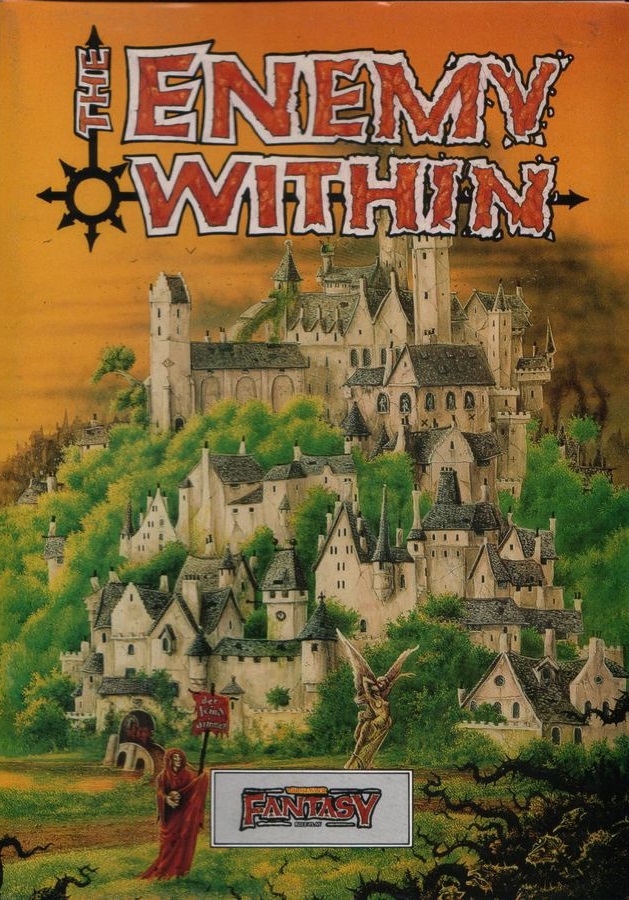
WFRP: The Enemy Within

Designed by: Phil Gallagher, Graeme Davis, and Jim Bambra

Published by Cubicle 7


Released in 1987 for Warhammer Fantasy Roleplay 1st edition, The Enemy Within would kick off one of the most highly regarded published campaigns. Even Game Masters who don't get much from pre-written adventures are drawn to it and with good reason. The Enemy Within took what made WFRP so compelling, emphasized it, and threw out everything that didn't work. It also gives GMs a guide to writing adventures for traditional action driven RPGs. Even as a self contained book, The Enemy Within stands out as an atmospheric narrative that balances humor and horror as the players explore a world seething with corruption, poised on the brink of total destruction.

Lay of the Land


Admittedly, the 57 page book feels like a primer for the rest of the campaign. The actual adventure portion takes up only a third of the book, not counting the pages of handouts. Future reprints of The Enemy Within would be rolled in with the second adventure Shadows Over Bogenhafen. I also suspect that was to offset the fact that the campaign itself was quickly refereed to as the The Enemy Within.

While it seems jarring to dedicate so much of an adventure book to background material, it's part of what makes The Enemy Within so exceptional. The book gives exhaustive advice on how to sustain a long running campaign and more specifically this pre-written one. This advice has stood the test of time and doesn't repeat too much from the core rulebook. In fact, I'd put it slightly above the rulebook's approach, as by The Enemy Within, the writers had a much clearer grasp of what WFRP was supposed to be. Dungeons & Dragons trappings have been thrown aside for political corruption, religious conflicts, and carriage crashes.

Saturday, May 9, 2020

Everyday Heroes and Villains: A Warhammer Fantasy Roleplay 1st Edition Review


Cublicle 7 (John Sibbick)

While Dungeons & Dragons struggled with Satanic Panic driven controversy throughout the 80s, famous British wargaming property Warhammer took a very different approach. Published in 1986 by Games Workshop, Warhammer Fantasy Roleplay invited players to explore "A grim world of perilous adventure." That doesn't even begin to describe the horror and bloodshed the system captures or the all too human adventurers that stands against certain destruction.

WFRP 1st edition was released while the mass combat game Warhammer Fantasy Battle was still in its early years. At that time, it was simply known as Warhammer and much of the game's background, rules, and identity was still in flux. Even three editions by that point, the game was an interesting mix of Roleplaying elements and more contemporary wargaming mechanics. WFRP 1st edition would end up bringing a lot of clarity to Warhammer Fantasy as a whole. Besides the wargame aspect, it also proved to be one of the most atmospheric RPG systems ever published and my all time favorite.

The usual Warhammer tropes are all in force in WFRP. Reality is poised to be destroyed by the extradimensional forces of Chaos, who take the shapes of gods and daemons. Besides the direct threat they pose, their plans have left mortals at each others throats. WFRP frames this conflict in a fantasy setting that's a mixture of real world history, Michael Moorcock's Elric series, Tolkien fantasy, Conan, and the other usual suspects.  

WFRP 1st edition was very much a setting driven game, with most of the background information is restricted to games set in the "Old World," which roughly conforms to Medieval Europe geographically and culturally. While the scope was somewhat limited, what they did cover was well explored both in and out of game.

This might not sound very original but what set WFRP apart from the rest was the presentation of these well worn inspirations. There's a strong punk atmosphere to early Warhammer, as traditional fantasy tropes were placed in a corrupted world that drew inspiration from Thatcher England and Cold War fears. Most importantly, WFRP 1st edition was all about playing the little guy. You didn't make heroes, you made characters who could be heroes.

That distinction makes all the difference in the world.

WFRP 1st edition is a game where no matter how strong or experience a character is, nearly anything can kill them: goblins, wild animals, carriage crashes. Meanwhile, the more supernatural threats and the corrupt institutions that rule over the Old World represent an ever greater danger.

The inherent risk of the setting is reflected in a rule set hellbent on tearing life and limb away from the characters. Most of the mechanics stem from a percentile system. For an action to succeed, a player just needs to roll a d100 die below the relevant characteristic, after difficulty modifiers (+10, -10, so on). Easy to learn, hard to actually pull off, much like the rest of the game.

A Twist of Fate

Cubicle 7 (Tony Ackland)

The way you build characters in WFRP is a major contributor to the overall lethality of the game. It's also my favorite part of this system. As I said before, you're making potential heroes. You start by picking one of the four available races, Human, Wood Elf, Dwarf, and Halfling. They're all what you expect.

I often hear people say Elves are too powerful in WFRP 1st edition. They certainly have some notable advantages compared to the other options but in my experience it doesn't matter much. Frankly any mechanical advantages are nullified by the unforgiving nature of the game and the setting's harsh cultural norms.

Friday, July 19, 2019

Seven Pages of Horror- "Night of Blood" for Warhammer Fantasy Roleplay


                                                                                                                 Cubicle 7

Warhammer Fantasy Roleplay 1st edition earned its legendary status through high quality pre-written adventures. The six-book long Enemy Within campaign is regarded as one of the best ever written, and with good reason. But WFRP had plenty of other scenarios that have gone largely overlooked. My personal favorite has always been Night of Blood.

Originally published in issue 87 of White Dwarf magazine, Night of Blood was only seven pages long. Written by Dungeons & Dragons mainstay Jim Bambra, it’s nothing short of a triumph of game design. The adventure perfectly conveys the tone, themes, and gameplay that defined classic Warhammer.

Like all great WFRP stories, Night of Blood starts with a stage coach crash. Stranded in the middle of a thunderstorm on a secluded, wooded road in the Empire, the adventurers find themselves surrounded by the mutants responsible for the accident.

Night of Blood is one of the rare examples of “in media res” storytelling in a published RPG scenario. It does away with any awkward introductions and plunges the players right into WFRP’s “grim world of perilous adventure.” Emerging from the crash to discover a dog headed mutant devouring the coachman tells the players more about Warhammer than any exposition ever could.

Aside from its effective simplicity, the opening sets up Night of Blood’s “out of the frying pan into the fire” narrative. The adventurers quickly discover that the only respite is the nearby Hooded Man inn. Unfortunately, what lies within is much worse.

While the roadside inn is a well-established part of RPG mythology, Night of Blood uses it in a very novel fashion. Bambra offers a quick summary of its secret, dark history as a place of chaos worship. But the players aren’t privy to that information. 

Even then, it’s immediately clear that something foul is afoot. The Hooded Man inn’s inhabitants have been butchered or captured by chaos cultists, in preparation for a ritual. The cultists don’t expect the adventurers’ arrival. They pose as the owners and patrons they’ve attacked while they figure out how to deal with their unexpected guests.

While not particularly well defined, the chaos cultists are memorable adversaries. They offer a wealth of roleplaying potential. The cultists also serve as a realization of Warhammer Fantasy’s dark humor.

All things considered, they're a relatively mundane bunch, aside from some mutations that range from awkward to horrifying. To even the fight against any nosy adventurers, the cultists rely on dirty tricks. They force the players into unfortunate circumstances any chance they get.

The cultists’ constant deception offers a perfect example of good enemy design. None of them are particularly imposing, neither individually nor together. But the scenario forces the adventurers to fight them alone in confined spaces, atop slippery roofs, or under the influence of sleeping draughts.

And that’s assuming they even manage to see past the bloodstained disguises in time.

Just about every GM is tempted to make custom, beefed out adversaries to throw at their players, each one with a wealth of homebrewed abilities. Meanwhile, Night of Blood takes some of the most basic enemies from the core book and makes them lethal by placing them in the right circumstances.

Night of Blood eschews the cycle of introducing bigger and badder monsters. Instead, it shows the value of an “average” adversary that strikes the players at the worst possible moment and in a cunning way. The is much more engaging than the former.

As is appropriate for such underhanded enemies, the cultists are doomed regardless of the player’s actions. Even if they successfully complete the ritual, they discover summoning a daemon is a death sentence without a binding spell at the ready.

Like most of Night of Blood, the climax is mechanically and narratively fulfilling. The daemon’s betrayal ties into the self-destructive nature of chaos and its followers, as well as Warhammer’s larger themes of lethal failure.

The nameless daemon breaks up the player/enemy/ally dichotomy that so many games fall into, as the nightmare can’t be bothered to make those kinds of distinctions. The daemon is the “final boss” but the context surrounding it ensures that the adversary is properly integrated into the story and not just a gameplay contrivance.

Like any good scenario, there are multiple ways the Night of Blood can unfold. It’s plotted loosely enough that the GM doesn’t have to railroad the players for the story to unfold as intended. Regardless of whether the adventurers are triumphant, they have to answer for their actions in the morning.

At the end of Night of Blood, Roadwardens arrive at the Hooded Man Inn and discover the carnage. With no one else left alive, it’s up to the adventurers to get themselves out of trouble.

In WFRP even the most seemingly defensible of actions have consequences. In Warhammer, victory is never as simple as killing the enemy and Night of Blood conveys that all important theme.

Night of Blood is a perfect example of something more than the sum of its parts. By pulling together various elements, Bambra produced the perfect introduction to the tone, themes, and concepts of Warhammer. The adventure’s a constant fight for survival, one so vicious that it swings between being absurd and terrifying when it doesn’t fall somewhere in between.

Night of Blood has been updated and reprinted a few times, most recently as a free PDF release for WFRP 4th edition, published by Cubicle 7. I can’t think of a piece of media that captures the horror, brutality, and comedy of Warhammer Fantasy so succinctly, so it's a good choice for a free adventure.

This newest rendition of the adventure removes some of the flair from Bambra's writing and lacks Russ Nicholson's appropriately grimy art. Scott Purdy's new illustrations at least have an appropriately Warhammer flair that nearly all of the modern artists to work on the franchise have lacked. More importantly, the rewrite keeps the narrative core of the adventure while still delivering it to a modern audience.

At the end of the day, it doesn't matter which version of Night of Blood you end up running. Just so long as your players end up paying a visit to the Hooded Man Inn.

Saturday, April 13, 2019

Book Review- Drachenfels


                                                             Black Library


A reprint of Drachenfels is a part of the opening for Games Workshop’s recently announced Warhammer Horror line. Originally published in 1989, the book was one of the earliest pieces of Warhammer fiction, predating even Black Library. Written by esteemed horror novelist Kim Newman under the penname Jack Yeovil, the book told the tale of the titular “Great Enchanter” and the adventurers who slew him. 25 years after their apparent victory, the traumatized survivors of that quest gather for a play recounting their triumph. Unfortunately, Drachenfels' dark powers are so great that they extend from beyond the grave...

While it has some issues, Drachenfels is in most respects the gold standard of Warhammer fiction. It has a fleshed out cast and a compelling villain. That's coupled with a complete narrative arc, which includes a satisfying and uncharacteristically upbeat ending. The novel fully explores Warhammer Fantasy’s setting, while providing enough context to stand on its own. All in all, it's a competently crafted story. Drachenfels has a lot more intelligence than you'd expect from licensed fiction, even if can be a little too obvious at times.

Many recommend Drachenfels as an introduction to Warhammer Fantasy’s setting and with good reason. The book fully realized the grimy world of political intrigue, strange magic, and brutal carnage previously established in magazines, army books, and RPG supplements. Drachenfels examines crucial concepts like the gods, Imperial politics, Sigmar, mutation, and even the alien Slann’s hand in shaping the Warhammer World. But most impressively, it puts all of it in a grounded context that still does those concepts justice. Part of what distinguished Warhammer Fantasy’s setting from so many other tabletop games was how the world felt like one people actually lived in.

Friday, January 25, 2019

Book Review- Gotrek & Felix: Trollslayer


                                                                                                                                                      Black Library
 
The Gotrek & Felix series was one of the most enduring elements of Warhammer Fantasy, what was once Games Workshop’s primary wargame. The books would later become the foundation for Black Library as one of its most successful and longest running ventures. However, Gotrek & Felix’s earliest entries predated the publisher it would help build, all of them written by prolific Warhammer author William King. The first book in the series, Trollslayer, was published in 1999. However, every story in the anthology had been published over the course of the previous decade. They had primarily appeared in rulebooks, as well as the magazines White Dwarf and Inferno! Trollslayer simply collected these stories, while future entries would be novel length. Gotrek & Felix came to a conclusion alongside the setting it was so integral to with 2015’s Warhammer Fantasy: The End Times. However, Trollslayer was developed when the wargame was at its peak. Even if it doesn’t always seem that way.

Trollslayer’s various stories all follow Felix Jaeger, a university student turned fugitive after a dueling mishap, and Gotrek, a Dwarf fanatic that has sworn to seek death in battle. Oft referenced but unseen events see Felix swear to spread the tale of Gotrek’s journey after his demise. However, that means he has to be there when it happens. Unfortunately, that’s not as close as either of them imagined, as they find themselves venturing into the darkest depths of the Old World.

Friday, December 7, 2018

David Gallagher's Art Brought Warhammer 40K and Fantasy to Life


                                                                  Games Workshop (Inquis Exterminatus)
 
David Gallagher is just one of the latest great artists to part ways with Games Workshop, the company responsible for the iconic wargames Warhammer 40,000, Warhammer Fantasy, and their countless other offshoots. Those games owed much of their success to their compelling, dark settings, which were fleshed out by the stunning, unique work provided by dozens of artists. David Gallagher did art for Games Workshop since the earliest editions of both Warhammer systems and left a lasting impact on each one. Games Workshop has never had a shortage of talented artists, but Gallagher offered a human image of distinctly dehumanized settings, presenting work at a level that few other tabletop game artists have managed.

As fond as I am of Warhammer in both its iterations, I’ll admit the art can blend together. It’s gothic, oppressive visions of hostile worlds lends itself to a certain level of monotony. The increasing focus on depicting the miniature kits sold by Games Workshop didn’t help matters, especially when it came to variety. This approach did give Warhammer some much needed consistency, as the settings managed to establish themselves with their signature rough, harsh artwork. Gallagher’s pieces stood out from this paradigm with his more organic, softer designs and a middle ground between the more realistic and abstract styles of his Warhammer peers.