Showing posts with label Warhammer. Show all posts

Wednesday, February 9, 2022

Convergence - A Warhammer Fantasy Role Play: A Rough Night at the Three Feathers Review


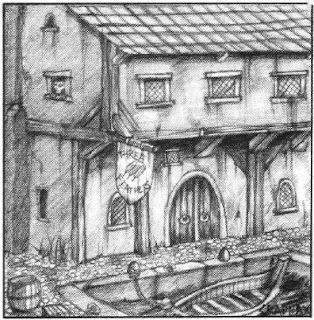
The title card of "A Rough Night at the Three Feathers," with an inn sign depicting the establishment name and three parallel feather emblem worked into it.
Cubicle 7

The tavern is such a staple of fantasy roleplaying games that starting a campaign in one is a cliche at this point. But well before that introduction outstayed its welcome, published material for Warhammer Fantasy Roleplay 1st edition featured inns and taverns prominently. It makes sense, considering WFRP has always been standard fantasy at its core, though the gothic and British punk influences - with a healthy dose of dark humor - distinguished it immediately.

A Rought Night at the Three Feathers covers all those bases, a Graeme Davis penned, seven page adventure published in White Dwarf issue 94 and later reprinted in Apocrypha Now and The Restless Dead. Broadly there are some similarities to Jim Bambra's Night of Blood, even down to the naming conventions. Sharing the same basic premise, the module saw the adventurers retiring for the night only to get far more than they bargained for.

Exterior shot of a dingy, medieval fantasy flavored timbered inn with a three freathers sign near the door. A rowboat is tied up outsied it.
Cubicle 7
Night of Blood might have been relatively complex for its short length but A Rough Night at the Three Feathers is far more experimental, by Davis' own description. Though no mutants are on the characters' trail this time, the adventurers end up embroiled in a murder mystery, a noble's entourage, another visitor's extramarital affair, and of course, a Chaos cult.

Now where did my coin pouch go...

The scenario sports seven plotlines unfolding over the course of a single night, most with multiple personalities involved. A few can play out fully devoid of player involvement or the motives are left unknown to the players. 

Experimental is certainly the word for Rough Night, which more than lives up to its name with such a short page count and time frame. On its face it seems daunting to run. Admittedly I had to read it over four or five times before running it myself.

Despite what one might think, the short length is why this scenario works at all. Seven plotlines is a lot to keep track of, in part because they intersect so much. Rough Night even recommends dropping a few if needed. A longer page count would require too much back and forth,

Tuesday, December 28, 2021

Know No Fear - A Warhammer 40,000: Space Marine (2011) Review


Titus, a space marine with black hair and a bulky suit of blue, gold trimmed power armored, rises up amid gothic ruins, clutching a mighty chainsaw-sword.
Games Workshop/Sega

Though the property grows increasingly prominent outside of wargaming miniature circles, Warhammer 40,000 doesn't have much to show for it video game wise. There are two big exceptions; Real Time Strategy classic Dawn of War and the third person, melee heavy shooter Space Marine.

The player controls Captain Titus of the Ultramarines, a chapter of the superhuman warriors known as Space Marines. His company is dispatched to the Forge World Graia, one of the foundries that supply the galaxy spanning Imperium's endless wars and now the site of a full scale Ork invasion. It's up to Titus to save Graia, now a ruined planet on the brink of defeat, though more dangerous foes may yet lie in wait.

Published by the now defunct THQ, Space Marine is one of the AA games that have largely gone extinct, overshadowed by gargantuan, big name undertakings and surprise Indie hits. And Space Marine is certainly middle of the road. 

A space marine firing his boxy boltgun into an approaching horde of green, axe wielding Orks amid ramshackle fortifications.
Games Workshop/Sega
There's nothing particularly revolutionary about the game, which plays very similarly to Gears of War, trading out cover mechanics for a regenerating shield and an emphasis on messily dispatching enemies with chainswords and similarly anachronistic melee weaponry.

Gameplay wise, Space Marine finds a nice balance between melee and raged options. Titus' main gun is the iconic bolter, which in this game is a compromise between the rocket powered explosive launcher of the lore and the lower caliber assault rifle seen in most adaptations. 

The game cleverly translates other tabletop weaponry into shooter staples. The anti-tank melta gun is akin to most shooters' shotguns and the lascannon serves as a sniper rifle best used for tankier ranged enemies. It's a good mix of weapons that are satisfying to use and benefit from some excellent sound design, adding to their existing weight. 

Melee weapons are less varied. Though the four options receive different animations, most feel like cosmetic changes outside of damage output, barring the appropriately unwieldy but capable Thunder Hammer.

Enemy wise there's even less of a mix, though that's partially because the source material leaves them in a tight spot, though the lack of character model variation draws attention to it. Combat mainly boils down to dispatching large waves of axe wielding enemies,

Wednesday, October 13, 2021

Decades of Golden Demon - A COMPENDIUM Volume One Review


A picture of Compendium's Cover, emblazoned with a grinning yellow, blue eyed demon.
The Miniatures Compendium

Golden Demon has long been a major institution of the Warhammer hobby, a miniature painting competition first held at the 1987 Games Day, Games Workshop's premier convention in ages past. It was eventually untethered from the trademark event, which disappeared in the warp around 2014. Golden Demon lived on, though COVID has given us a 2 year hiatus.

A two page spread of Compendium, depicting a power armored figure clashing with a leaping, axe wielding cultist.
The Miniatures Compendium/David de Blas
It's hard to described the importance of Games Day, both personally and otherwise. It's especially hard perhaps because I've never been a particularly good painter. Golden Demon winning miniatures have been intimidating just as often as they've been inspiring. But I suppose that's part of the mystique.

Games Workshop injected plenty of pomp and ceremony into Golden Demon without making it too daunting for hobbyists: the titular leering demonic trophies became a symbol of a truly accomplished painter, with the best in show awarded the Slayer Sword, a steel replica weapon.

I certainly never imagined myself winning a Golden Demon, much less triumphantly holding the Slayer Sword aloft. Even so, trawling through the Golden Demon galleries as a neophyte hobbyist a decade ago is a memory I treasure dearly.

Tuesday, June 15, 2021

Hellish Harvest - A Warhammer Fantasy Roleplay: Grapes of Wrath Review


The title card for GRAPES OF WRATH.

 Warhammer Fantasy Roleplay: Grapes of Wrath

By Carl Sargent with Derrick Norton 

Published by Games Workshop

Published in White Dwarf issue 98, Grapes of Wrath was intended to serve as "a prelude to The Power Behind the Throne and continuing The Enemy Within Campaign." However, this 18 page Warhammer Fantasy Roleplay adventure could easily be played independently or as a part of your own campaign, as the writer is quick to point out.

Set in the small but prosperous village of Pritzstock, a few miles away from the city of Middenheim, the adventurers discover that the villagers are being plagued by flying skulls on the eve of their annual grape harvest. Besides the physical danger posed by the skulls, the loss of the town's sole source of income is perhaps an even greater threat. The adventurers find themselves embroiled in the mystery of the skulls, which proves to be even more complicated than it first appears.

Grapes of Wrath follows the standard format for WFRP 1st edition adventures. The players are dropped into a colorful setting with a cast of dynamic characters, all of whom have their own agendas. A sort of sandbox approach is taken. certain events will happen no matter what, though ultimately the resolution comes down to how the players approach the situation. It even opens with a carriage crash, one of the most recognizable 1E hallmarks.

Sticking to the format is hardly a bad thing, considering this is WFRP 1E. Both the players and game masters are given plenty to play with, as most events can unfold a number of different ways. Even so, there's still a looming threat to keep players on track. 

In this case, it's dealing with the skulls before the harvest spoils and Pritzstock is ruined financially. A more practical and believable motive than a lot of fantasy plots.

Four skulls with glowing eyes, hovering outside of a cave. One of them has a horn sticking from the top of his skull.
Games Workshop
There's also an interesting cast of characters. Pritzstock's inhabitants prove to be stuck up and often unhelpful. The PCs main contact is the boisterous Bretonnian Henri-Philipe Rocheteau, mayor of Pritzstock, who struggles to control the situation as well as his personal life, all of which is harmed by his domineering personality.

There's plenty of ways for the player characters to get in trouble, a few of them far from the main plot. In one popular fantasy trope that doesn't make it into many RPGs, player characters can end up in a duel with the local noble if his love interest gets too involved with any of them.

Tuesday, June 8, 2021

Horus Rising - A Horus Heresy Novel Review


The cover of Horus Rising. Amid a battlefield of grey armored space marines, one with long black hair triumphantly directs his brothers towards the walls beyond.
Black Library

The Horus Heresy Book 1: Horus Rising

By Dan Abnett

Published by Black Library

Published in 2006, Horus Rising would kick off The Horus Heresy, a fifty book series with dozens of accompanying novellas and audio productions, as well as its own dedicated gameline by Forge World. Set 10,000 years before the grimdark future of Warhammer 40,000, The Horus Heresy depicted the cataclysmic civil war that saw the mighty Space Marine legions clash, the Emperor reduced to a permanent near death state, and the Imperium set on a course towards certain destruction.

The conflict itself is one of the fundamental components of the setting, dating back to the earliest Warhammer 40K publications. Even with a slew of magazine articles, rulebook blurbs, and prose references, much of the Horus Heresy was still left shrouded in mystery.

With Horus Rising's release in 2006, the definitive tale of the Horus Heresy had arrived. There was no initial set number of books for the series. As releases came out and many ended up on The New York Times bestseller list, it ballooned in length, to the point that only just now are we getting the conclusion with the Siege of Terra novels, 15 years later.

Penned by Warhammer fiction heavy hitter Dan Abnett, Horus Rising gave a new, intimate look at the Heresy. The demigod-like Primarchs and their legions of superhuman Astartes, the Space Marines, were no longer indistinct mythological figures but concrete characters. This initial book takes place years before the Heresy's actual start. Horus, of the conflict's namesake, is not the thrice damned traitor and herald of Chaos but instead the Emperor's most trusted servant and closest friend.

Horus Rising follows his earliest actions as Warmaster, the leader of humanity's galaxy conquering Great Crusade, showing events that would lead him down a dark path. The story unfolds across three different planetary conquests. Each one poses a unique set of challenges, physical and otherwise. That's broken up with a few well crafted horror segments featuring Chaos, the daemonic forces the Imperium has forgotten to fear thanks to the Emperor's enforced faithlessness. 

It's a decent mix of worldbuilding, character drama, and the combat heavy "Bolter Porn" most Black Library novels devolve into. At the very least, Horus Rising lends real narrative weight to its battle scenes. It likely has my favorite opening of any Black Library book, in which Horus' vicious Astartes descend on Terra, shatter the Imperium, and even mortally wound the Emperor.

Just not the Emperor, Terra, or even Horus you're thinking of, even if it does distill the Horus Heresy in a broad, ironic sense.

Abnett wisely doesn't tell Horus Rising from Horus' perspective, with most of the story told through the eyes of rapidly ascending Space Marine captain Garviel Loken. An uncomplicated, adventurous spirit, he finds himself thrust into the Warmaster's inner circle, the Mournival. A position that requires far more than just swinging a chainsword and one that exposes him to some difficult truths. The rest of the book takes on the point of view of the merely human entourage of the expedition fleets

I haven't loved every addition The Horus Heresy novels have made. In fact, a few of them soured me on the series as a whole. But the idea of Remembrancers, a collection of artists, writers, and other visionaries sent to record the Legiones Astartes "Great Deeds," as they carve a bloody path across creation, is just brilliant.

They're a strong assortment of characters, lending a more human vantage point to a narrative notably lacking one. The Horus Heresy was fine as the domain of great heroes when it was a distant, mythological event but a full length novel benefits from the likes of blundering poet Ignace Karkasy and adventurous photographer Euphrati Keeler. Abnett's writing certainly feels a lot more at home with these dreamers, who find their values tested and reshaped by their inhuman subjects. Just compare the surprisingly entertaining musings on Karkasy's notebooks with any of the fight scenes.

At Horus Rising's best points, the Remembrancers are used to question the heroic narrative that's sprung up around Space Marines, both in and out of universe.

Admittedly, Horus Rising doesn't neglect its Space Marine characters. While they're by far the most popular faction, supersoldiers that live only for war is a concept with very limited storytelling potential, something Abnett has admitted to struggling with in the past. Admittedly, the Heresy era gives him more to work with: though still single minded, the Astartes of the 31st millennium are more carefree and contemplative than their fanatical far future counterparts.

Horus Rising never adopts the titular Warmaster's point of view, leaving the reader to work mostly with other people's perspectives of him. This helps Horus retain a sense of mythos around him, while playing into his characterization. Though a more jubilant figure than one would expect, Horus is sorely alone in a galaxy that grows smaller by the day.

For all his grandiosity, he's a cypher to the reader as well as the other characters, not helped by how misdirection is his favorite tool. The starstruck Loken comes to realize this, most memorably noting that even Horus' accent is fake.

In addition to his duplicitous behavior, he's as violent and exacting as you'd expect from his reputation. That's balanced by Horus' surprising open mindedness and wisdom, things that his "sons" and other peers notably lack.

In Horus Rising, Abnett builds off of the established details of Horus feeling abandoned by the Emperor, extending it to a growing contempt for the increasingly pointless bloodshed he's been left to watch over.

That mirrors the overall theme of the book. Every principal character comes to realize they don't actually understand much less fully believe in their duty. Even if they're not quite yet ready to admit that. It's a much more compelling root for the Heresy than purely chalking it up to the interference of dark gods.

Even if it is the gateway to an entire subsection of the setting, Horus Rising isn't an ideal introduction to Warhammer 40K. It's a memorable book, surely some of Black Library's best, one that even rediscovers some of the series' long lost sense of humor. But many scenes rely on the reader's knowledge of what these characters and factions will go on to do. Usually it's very obvious, verging on being clumsy at points. A couple of clever scenes lose their staying power if you don't have that background.

More broadly, the dystopia glaring beneath the glamour of the Imperium's golden age works best when you know the absolute nightmare it leads to in 10,000 years. The same goes for the mood of the book as a whole.

At the time of Horus Rising’s release, there was a lot of grumbling about the very idea of a book Horus Heresy series. Even with all the prior material, much of the Horus Heresy was still left up to the players to define, the details lost to history. Many fans were concerned a novel series following the conflict could undermine its legendary status, pulling back the curtain too much.

The older I get, and the longer the series and its spinoffs drag out, the more I’m inclined to agree with that stance. The Horus Heresy no longer felt like a sort of militarized creation myth but just another story, with some bizarre changes and questionable additions to boot. 

On the other hand, it did lead to some of my favorite Warhammer fiction and the fully developed ruleset for the era.

When I read Horus Rising this time around, I saw a parallel of the series "de-mything" with the book’s underlying sense of loss, that these half remembered better days will soon be replaced by tragedy. Less dramatically, I think Horus Rising proved that the sense of mystery didn't need to be sacrificed for a more nuanced, developed perspective. 

A few of the later installments managed to achieve that too, even if many more Horus Heresy books presented the conflict like any other Black Library story.

Saturday, March 6, 2021

Are We the Baddies? - A Warhammer 40K: Dark Heresy 1st Edition Review


The cover of Dark Heresy. A bolt pistol, armored interogator takes center, flanked to his left by a leather clad, sword wielding assassin and to his right by a veteran, lasgun toting soldier with a cybernetic eye.
 
Dark Heresy

Designed by Owen Barnes, Kate Flack, and Mike Mason

Cubicle 7

In the dark future of the 41st millennium, humanity has few defenders left. In fact, we've become our own worst enemy, as trillions live under the oppressive Imperium of Mankind. Zealotry and intolerance are abundant as humanity constantly fends off the countless enemies it has accumulated over the last ten millennia. Its founder, the God-Emperor of Mankind, clings to life through arcane technologies. Little more than a corpse, his psychic might barely holds his crumbling domain together and his priests claim he single-handedly prevents human extinction. But even this won't be enough in the face of dark gods and all consuming aliens more villainous than even the Imperium.

In Dark Heresy, players take on the roles of Acolytes, the foot soldiers and investigators of the infamous Inquisition. The Imperium's feared secret police, they root out threats to the "human soul" wherever they might lie, even within their own ranks. 

Inquisitors wield the authority to put entire planets to death but Acolytes end up doing most of the dirty work. They'll be thrown into the labyrinthine politics and dark secrets of the Calixis Sector, a particularly volatile patch of an empire in peril. 

With nothing to call on but their own wits and whatever firearms they can carry, Acolytes will have to root out and destroy various threats. Malicious cults, reality warping daemons, and ruthless aliens lurk around every corner. Acolytes stand to lose life, limb, sanity, and even their souls in the quest to buy humanity even another day.

Dark Heresy was the swan song of Black Industries, Games Workshop's short lived return to RPG publishing. Built off of the second edition of Warhammer Fantasy Roleplay and the hybrid RPG-wargame Inquisitor, Dark Heresy was released in 2008, one month before Black Industries closed its doors. The Calixis Sector would live on at Fantasy Flight Games, who would publish the rest of the line and its future companions like Deathwatch and Rogue Trader. Even so, none of the future endeavors would ever quite match Dark Heresy. Though not without its flaws, it was a worthy inheritor of the WFRP mantle, a great way to live out the Dark Millennium, and a solid RPG in its own right. 

Regardless of how good of an adaptation it is, Dark Heresy has a powerful hook: hard bitten investigators struggling against horrors from beyond the stars and those within their own hearts.

A Less-Than-Heavenly-Host

Character creation is fairly in line with the prior WFRP books, with the consolidated stats of WFRP 2nd edition. Notably, a Perception stat has been added and the admittedly wargame-y Attacks has been removed. This game offers no species or races besides human: the humanity of the Dark Millennium is a superstitious, xenophobic lot and doubly so in the Inquisition. To compensate are the somewhat more flavorful "Homeworlds." Players get to pick from the dominant worlds in the galaxy spanning Imperium: lawless Feral Worlds, mega city wracked Hive Worlds, the starship bound Void Born, with the rest coming from the average Imperial World.

A board a spaceship, a bald tattooed woman with a grille and pipes built into her neck clutches a futuristic crib, an infant visible through the smokey glass. A crowd of barely visible figures can be made out behind her.
Cubicle 7
The Homeworlds are admittedly a little more robust than the standard, currently under fire approach to species in most RPGs. While there are stat modifiers for each option, they're a result of culture and environment rather than somehow inherent. The actual statistical differences are limited to 5%, with most of the differences coming from atmospheric talents. Hive Worlders are frightened by the open skies, Feral Worlders care little for advanced technologies, and even regular Imperial Worlders are emboldened by the assertion that "Of all the planets in the Imperium, theirs is, in fact, the most beloved of the Emperor."

The all important Fate points make their return as a limited pool of bonuses and rerolls that replenish each session. They also have their classic purpose, to be permanently spent to stave off death.

Thursday, July 2, 2020

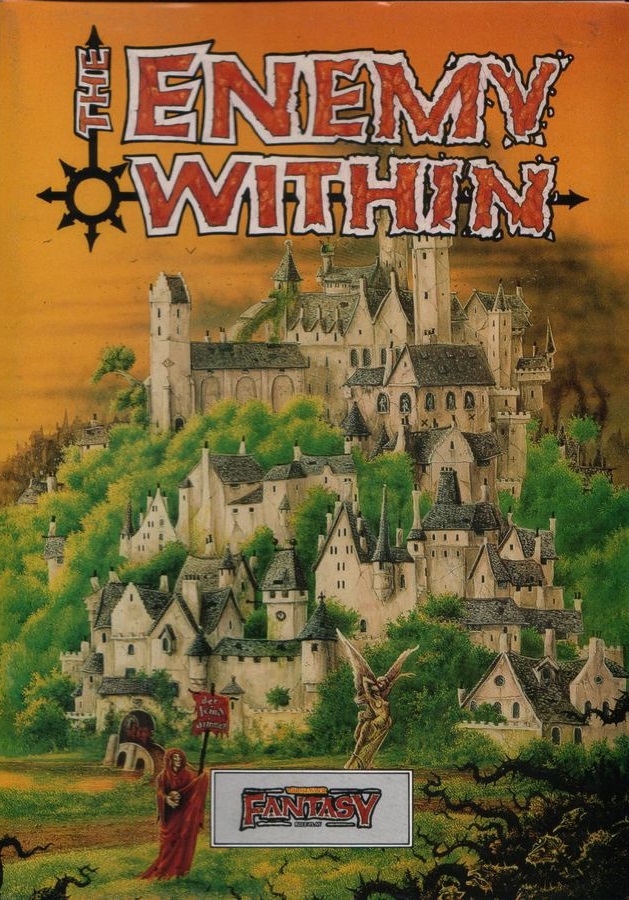
Road Trip From Hell - A Warhammer Fantasy Roleplay: The Enemy Within Review

 
Cubicle 7

WFRP: The Enemy Within

Designed by: Phil Gallagher, Graeme Davis, and Jim Bambra

Published by Cubicle 7


Released in 1987 for Warhammer Fantasy Roleplay 1st edition, The Enemy Within would kick off one of the most highly regarded published campaigns. Even Game Masters who don't get much from pre-written adventures are drawn to it and with good reason. The Enemy Within took what made WFRP so compelling, emphasized it, and threw out everything that didn't work. It also gives GMs a guide to writing adventures for traditional action driven RPGs. Even as a self contained book, The Enemy Within stands out as an atmospheric narrative that balances humor and horror as the players explore a world seething with corruption, poised on the brink of total destruction.

Lay of the Land


Admittedly, the 57 page book feels like a primer for the rest of the campaign. The actual adventure portion takes up only a third of the book, not counting the pages of handouts. Future reprints of The Enemy Within would be rolled in with the second adventure Shadows Over Bogenhafen. I also suspect that was to offset the fact that the campaign itself was quickly refereed to as the The Enemy Within.

While it seems jarring to dedicate so much of an adventure book to background material, it's part of what makes The Enemy Within so exceptional. The book gives exhaustive advice on how to sustain a long running campaign and more specifically this pre-written one. This advice has stood the test of time and doesn't repeat too much from the core rulebook. In fact, I'd put it slightly above the rulebook's approach, as by The Enemy Within, the writers had a much clearer grasp of what WFRP was supposed to be. Dungeons & Dragons trappings have been thrown aside for political corruption, religious conflicts, and carriage crashes.

Saturday, May 9, 2020

Everyday Heroes and Villains: A Warhammer Fantasy Roleplay 1st Edition Review


Cublicle 7 (John Sibbick)

While Dungeons & Dragons struggled with Satanic Panic driven controversy throughout the 80s, famous British wargaming property Warhammer took a very different approach. Published in 1986 by Games Workshop, Warhammer Fantasy Roleplay invited players to explore "A grim world of perilous adventure." That doesn't even begin to describe the horror and bloodshed the system captures or the all too human adventurers that stands against certain destruction.

WFRP 1st edition was released while the mass combat game Warhammer Fantasy Battle was still in its early years. At that time, it was simply known as Warhammer and much of the game's background, rules, and identity was still in flux. Even three editions by that point, the game was an interesting mix of Roleplaying elements and more contemporary wargaming mechanics. WFRP 1st edition would end up bringing a lot of clarity to Warhammer Fantasy as a whole. Besides the wargame aspect, it also proved to be one of the most atmospheric RPG systems ever published and my all time favorite.

The usual Warhammer tropes are all in force in WFRP. Reality is poised to be destroyed by the extradimensional forces of Chaos, who take the shapes of gods and daemons. Besides the direct threat they pose, their plans have left mortals at each others throats. WFRP frames this conflict in a fantasy setting that's a mixture of real world history, Michael Moorcock's Elric series, Tolkien fantasy, Conan, and the other usual suspects.  

WFRP 1st edition was very much a setting driven game, with most of the background information is restricted to games set in the "Old World," which roughly conforms to Medieval Europe geographically and culturally. While the scope was somewhat limited, what they did cover was well explored both in and out of game.

This might not sound very original but what set WFRP apart from the rest was the presentation of these well worn inspirations. There's a strong punk atmosphere to early Warhammer, as traditional fantasy tropes were placed in a corrupted world that drew inspiration from Thatcher England and Cold War fears. Most importantly, WFRP 1st edition was all about playing the little guy. You didn't make heroes, you made characters who could be heroes.

That distinction makes all the difference in the world.

WFRP 1st edition is a game where no matter how strong or experience a character is, nearly anything can kill them: goblins, wild animals, carriage crashes. Meanwhile, the more supernatural threats and the corrupt institutions that rule over the Old World represent an ever greater danger.

The inherent risk of the setting is reflected in a rule set hellbent on tearing life and limb away from the characters. Most of the mechanics stem from a percentile system. For an action to succeed, a player just needs to roll a d100 die below the relevant characteristic, after difficulty modifiers (+10, -10, so on). Easy to learn, hard to actually pull off, much like the rest of the game.

A Twist of Fate

Cubicle 7 (Tony Ackland)

The way you build characters in WFRP is a major contributor to the overall lethality of the game. It's also my favorite part of this system. As I said before, you're making potential heroes. You start by picking one of the four available races, Human, Wood Elf, Dwarf, and Halfling. They're all what you expect.

I often hear people say Elves are too powerful in WFRP 1st edition. They certainly have some notable advantages compared to the other options but in my experience it doesn't matter much. Frankly any mechanical advantages are nullified by the unforgiving nature of the game and the setting's harsh cultural norms.

Friday, September 20, 2019

Book Review- Gaunt's Ghosts: Necropolis


                                                         Black Library

Dan Abnett's Necropolis is the third book in the Gaunt’s Ghosts series, which follows the heroic commissar Abram Gaunt and his dwindling Imperial Guard regiment as they fight across countless warzones in the 41st millennium. Even a military fiction writer as competent as Dan Abnett can’t make an uninterrupted stream of battles interesting. Thankfully Abnett’s strong point is that his Warhammer fiction is never just about the fighting.

A considerable amount of Necropolis lacks Gaunt and his Ghosts. Most of the opening act is spent establishing Vervunhive and its rival Ferrazoica. Both are “hive cities,” termite mound like superstructures that house a considerable portion of the Imperium’s population.

Friday, July 19, 2019

Seven Pages of Horror- "Night of Blood" for Warhammer Fantasy Roleplay


                                                                                                                 Cubicle 7

Warhammer Fantasy Roleplay 1st edition earned its legendary status through high quality pre-written adventures. The six-book long Enemy Within campaign is regarded as one of the best ever written, and with good reason. But WFRP had plenty of other scenarios that have gone largely overlooked. My personal favorite has always been Night of Blood.

Originally published in issue 87 of White Dwarf magazine, Night of Blood was only seven pages long. Written by Dungeons & Dragons mainstay Jim Bambra, it’s nothing short of a triumph of game design. The adventure perfectly conveys the tone, themes, and gameplay that defined classic Warhammer.

Like all great WFRP stories, Night of Blood starts with a stage coach crash. Stranded in the middle of a thunderstorm on a secluded, wooded road in the Empire, the adventurers find themselves surrounded by the mutants responsible for the accident.

Night of Blood is one of the rare examples of “in media res” storytelling in a published RPG scenario. It does away with any awkward introductions and plunges the players right into WFRP’s “grim world of perilous adventure.” Emerging from the crash to discover a dog headed mutant devouring the coachman tells the players more about Warhammer than any exposition ever could.

Aside from its effective simplicity, the opening sets up Night of Blood’s “out of the frying pan into the fire” narrative. The adventurers quickly discover that the only respite is the nearby Hooded Man inn. Unfortunately, what lies within is much worse.

While the roadside inn is a well-established part of RPG mythology, Night of Blood uses it in a very novel fashion. Bambra offers a quick summary of its secret, dark history as a place of chaos worship. But the players aren’t privy to that information. 

Even then, it’s immediately clear that something foul is afoot. The Hooded Man inn’s inhabitants have been butchered or captured by chaos cultists, in preparation for a ritual. The cultists don’t expect the adventurers’ arrival. They pose as the owners and patrons they’ve attacked while they figure out how to deal with their unexpected guests.

While not particularly well defined, the chaos cultists are memorable adversaries. They offer a wealth of roleplaying potential. The cultists also serve as a realization of Warhammer Fantasy’s dark humor.

All things considered, they're a relatively mundane bunch, aside from some mutations that range from awkward to horrifying. To even the fight against any nosy adventurers, the cultists rely on dirty tricks. They force the players into unfortunate circumstances any chance they get.

The cultists’ constant deception offers a perfect example of good enemy design. None of them are particularly imposing, neither individually nor together. But the scenario forces the adventurers to fight them alone in confined spaces, atop slippery roofs, or under the influence of sleeping draughts.

And that’s assuming they even manage to see past the bloodstained disguises in time.

Just about every GM is tempted to make custom, beefed out adversaries to throw at their players, each one with a wealth of homebrewed abilities. Meanwhile, Night of Blood takes some of the most basic enemies from the core book and makes them lethal by placing them in the right circumstances.

Night of Blood eschews the cycle of introducing bigger and badder monsters. Instead, it shows the value of an “average” adversary that strikes the players at the worst possible moment and in a cunning way. The is much more engaging than the former.

As is appropriate for such underhanded enemies, the cultists are doomed regardless of the player’s actions. Even if they successfully complete the ritual, they discover summoning a daemon is a death sentence without a binding spell at the ready.

Like most of Night of Blood, the climax is mechanically and narratively fulfilling. The daemon’s betrayal ties into the self-destructive nature of chaos and its followers, as well as Warhammer’s larger themes of lethal failure.

The nameless daemon breaks up the player/enemy/ally dichotomy that so many games fall into, as the nightmare can’t be bothered to make those kinds of distinctions. The daemon is the “final boss” but the context surrounding it ensures that the adversary is properly integrated into the story and not just a gameplay contrivance.

Like any good scenario, there are multiple ways the Night of Blood can unfold. It’s plotted loosely enough that the GM doesn’t have to railroad the players for the story to unfold as intended. Regardless of whether the adventurers are triumphant, they have to answer for their actions in the morning.

At the end of Night of Blood, Roadwardens arrive at the Hooded Man Inn and discover the carnage. With no one else left alive, it’s up to the adventurers to get themselves out of trouble.

In WFRP even the most seemingly defensible of actions have consequences. In Warhammer, victory is never as simple as killing the enemy and Night of Blood conveys that all important theme.

Night of Blood is a perfect example of something more than the sum of its parts. By pulling together various elements, Bambra produced the perfect introduction to the tone, themes, and concepts of Warhammer. The adventure’s a constant fight for survival, one so vicious that it swings between being absurd and terrifying when it doesn’t fall somewhere in between.

Night of Blood has been updated and reprinted a few times, most recently as a free PDF release for WFRP 4th edition, published by Cubicle 7. I can’t think of a piece of media that captures the horror, brutality, and comedy of Warhammer Fantasy so succinctly, so it's a good choice for a free adventure.

This newest rendition of the adventure removes some of the flair from Bambra's writing and lacks Russ Nicholson's appropriately grimy art. Scott Purdy's new illustrations at least have an appropriately Warhammer flair that nearly all of the modern artists to work on the franchise have lacked. More importantly, the rewrite keeps the narrative core of the adventure while still delivering it to a modern audience.

At the end of the day, it doesn't matter which version of Night of Blood you end up running. Just so long as your players end up paying a visit to the Hooded Man Inn.

Saturday, April 13, 2019

Book Review- Drachenfels


                                                             Black Library


A reprint of Drachenfels is a part of the opening for Games Workshop’s recently announced Warhammer Horror line. Originally published in 1989, the book was one of the earliest pieces of Warhammer fiction, predating even Black Library. Written by esteemed horror novelist Kim Newman under the penname Jack Yeovil, the book told the tale of the titular “Great Enchanter” and the adventurers who slew him. 25 years after their apparent victory, the traumatized survivors of that quest gather for a play recounting their triumph. Unfortunately, Drachenfels' dark powers are so great that they extend from beyond the grave...

While it has some issues, Drachenfels is in most respects the gold standard of Warhammer fiction. It has a fleshed out cast and a compelling villain. That's coupled with a complete narrative arc, which includes a satisfying and uncharacteristically upbeat ending. The novel fully explores Warhammer Fantasy’s setting, while providing enough context to stand on its own. All in all, it's a competently crafted story. Drachenfels has a lot more intelligence than you'd expect from licensed fiction, even if can be a little too obvious at times.

Many recommend Drachenfels as an introduction to Warhammer Fantasy’s setting and with good reason. The book fully realized the grimy world of political intrigue, strange magic, and brutal carnage previously established in magazines, army books, and RPG supplements. Drachenfels examines crucial concepts like the gods, Imperial politics, Sigmar, mutation, and even the alien Slann’s hand in shaping the Warhammer World. But most impressively, it puts all of it in a grounded context that still does those concepts justice. Part of what distinguished Warhammer Fantasy’s setting from so many other tabletop games was how the world felt like one people actually lived in.

Friday, February 22, 2019

Warhammer Adventures- Not as Bad as You Think


                                                                                                                                                                       Games Workshop
 
When Games Workshop announced a line of young readers’ books titled Warhammer Adventures, there was something of a mixed response. Which is to say the primarily adult fans of Warhammer 40,000 and Age of Sigmar reacted with a mixture of anger, disdain, and mockery. I’ll admit I was in the last category. The various Warhammer products have been “toned down” throughout their history to accommodate a younger audience. But Warhammer Adventures is the first time Games Workshop has tried to explicitly market the settings that coined the word “grimdark” towards young children. The idea of converting the violent, oppressive worlds of Warhammer into kid’s books seemed downright laughable. But having read the free extracts, I’m surprised to say that Warhammer Adventures is surprisingly decent, all things considered.

The major concern about Warhammer Adventures was that they’d water down the settings. Some saw it as a personal attack on the hobby they loved. I was more confused how they intended to do that with Warhammer 40K, which is by design the worst future imaginable. My concerns about the setting being misrepresented were met by Warhammer Adventures: Attack of the Necron’s significantly abridged version of 40K’s iconic opening text. It begin with “Life in the 41st millennium is hard” and skips over the “eternity of carnage and slaughter and the laughter of thirsting gods” and “whatever happens, you will not be missed” portions. Aside from that, it’s a surprisingly faithful if more concise rendition the original. It reflects the rest of Attack of the Necron, which is accurate to the setting while still very much for kids.

The book isn't the most stimulating of reads for an adult, or even someone in their teens. But Attack of the Necron is perfect for what it is. It captures the mechanics and tone of the setting as accurately as it can. The story follows a group of kids at an archeological site for various reasons, brought together by circumstance and an invasion of Necrons. The book actually explained they aren’t robots, a common if understandable misconception. It didn’t get into the Faustian bargain that cost the ancient species their minds and souls but I didn’t expect the book to. I also have to compliment author Cavan Scott for avoiding the obnoxious “Space Marines as heroes” narrative that gains more traction with each passing year. The power armored super soldiers save the heroes by accident and even the children know it’s not safe to be around them. My main concern is that Warhammer Adventures would make the nightmarish Imperium of Man out to be the good guys. Thankfully it seems to have remembered they're far from the good guys. This is especially notable when you consider how the Warhammer media aimed at adults has trouble remembering that.

As for how Attack of the Necron reads, it has pretty decent characterization and dialogue for a children’s book. There’s a real peril to it and Scott wisely has the adults fully aware of grim realities that the kids are oblivious to. Though the older characters reactions are enough to tell them that something’s wrong. By the end of the excerpt I had a good grasp of who everyone was and what they value. I’d go as far to say that Attack of the Necron is in many ways superior to a lot the content Black Library puts out. Their books have long been referred to as “bolter porn” by the fanbase for their emphasis on fight scenes and little else. Even the excerpt of Attack of the Necron proves to be more inventive than that.

City of Lifestone drew a lot less derision than Attack of the Necron, mainly because Age of Sigmar has very little influence outside of the hobby, especially compared to 40K. However, I’ve always thought that Warhammer Fantasy Battle’s successor was closer to a Saturday Morning Cartoon than its far future brother. The much less developed setting also makes it a bit more suited for what Warhammer Adventures is trying to be than the comparatively rigid background of 40K. Age of Sigmar also sports a “good vs evil” cosmology that’s largely absent in most other versions of Warhammer, though this clear morality works better for a young readers’ book. 

However, City of Lifestone is much darker than its Attack of the Necron, despite the opposite usually being true when Age of Sigmar and 40K are usually compared. Most of the excerpt takes place in a slave camp, and the protagonist’s adventure starts with the death of her mother. Her subsequent arrival at the titular city, in which she discovers its little more than ruins and not the promised paradise, was handled in a very tragic way. Author Tom Huddlestron also doesn’t beat around the bush about the sort of moral code (or lack thereof) worshippers of Chaos follow. It’s not as graphic as I make it sound but it’s a lot more than I expected from a young readers’ book.
City of Lifestone reads very similar to Attack of the Necron, even in terms of setup, circumstances, and story beats. While I’m not compelled to read the full versions of either book, I will say that 40K got the better end of the deal than Age of Sigmar. Attack of the Necron has a little more going on with its setup and the way it handles certain elements and takes a lot less time to get interesting. That being said, City of Lifestone managed to make me laugh with the line “The Realm of Life was rightly named, every corner of it overrun with living things. The trouble was, most of them wanted to eat her.

Both Warhammer Adventures stories are accompanied by illustrations done by Magnus Norén. They’re better than most of what I’ve seen in children’s literature (a genre I admittedly haven’t been exposed to in a while.) However, it does run into a problem with Attack of the Necron. So much of 40K’s aesthetic relies on skulls, cyborgs, and other horrors. It’s difficult to translate all that into something kid appropriate and the at times simplistic art shows that. It doesn’t help that 40K art traditionally has a very intimidating, oppressive atmosphere that’s just hard to emulate in this playful style. Norén does a decent job for Attack of the Necron but his work is much better with City of Lifestone. The much tamer art direction of Age of Sigmar is better suited to the sort of atmosphere Warhammer Adventures is trying to capture and for its target demographic.

It goes without saying that Warhammer Adventures is for children. While the books don't contradict anything in the main material, it clearly isn’t meant to be a substitute or even a "real" addition. Barring extreme circumstances, I don’t expect a 35$ finecast Mekki miniature to come out. That makes the more vitriolic reactions even more confusing. I fail to see how Warhammer Adventures threatens the hobby and settings in anyway, despite the insistence of asmall but vocal group of fans. Warhammer Adventures is only meant to introduce younger people to the settings of Warhammer 40K and Age of Sigmar and I think it will do a decent job of that, at least from what's in the free sample.