Showing posts with label Rules Light. Show all posts

Wednesday, July 28, 2021

Bending the Rules - An Avatar Legends: The RPG Quickstart Review


The cover of Avatar: Legends. The avatar is at the center, the symbol of all four elements behind them. The left side is bald air nomad Aang and the left is water tribe sports star Korra. Their eyes glow with the shared power of the Avatar state.
Magpie Games

Avatar Legends: The RPG Quickstart

Designed by Brendan Conway, James Mendez Hodes, Marissa Kelly, Mark Diaz Truman, Miguel Ángel Espinoza, Sharang Biswas, Elizabeth Chaipraditkul, Yeonsoo Julian Kim, Daniel Kwan, and Sen-Foong Lim 

Published by Magpie Games 

When it comes to licensed RPGs, there's been a gaping, Avatar the Last Airbender shaped hole. The hit animated TV show follows Aang, the titular Avatar and reincarnating master of four elements, and his journey to bring peace to a world at war. The spectacle of element bending, along with the episodic format and strong character development, makes it ripe for a tabletop adaptation. 

Thankfully the wait will soon be over, because Magpie Games has announced Avatar Legends: The RPG. The company that published the critically acclaimed MASKS and Bluebeard's Bride, they recently released the free quickstart rules as a preview. It's a strong offering and shows a promising future for the game.

Like previous Magpie Games' publications, it uses the divisive Powered by the Apocalypse ruleset. I haven't had experience with it until now, but from what I've seen, many people refuse to play anything but and there's another vocal subset that want nothing to do with it.

Aang and his friends Katara, Sokka, and Momo hanging on tot the saddle of the Air Bison Appa for dear life as he makes a sharp turn near a mountain top.
Magpie Games
Going off of Avatar Legends, it's very much a storytelling driven approach to RPGs, and the experience is dependent on the group running it. There's not much to keep track of but it does take some getting used to how everything fits together.

Resolution is done with 2d6, with the relevant modifiers from your four Stats and other conditional factors. The Stats are in line with how we see the characters of Avatar solve their problems, consisting of Creativity, Focus, Harmony, and Passion. Rolling 1 to 6 is a failure, 7 to 9 is a "soft" hit, and 10+ is a full hit; a success and then some.

The game rarely gets more complicated than that, though there are two very interesting aspects that stick out to me. A character's negative emotional state is represented mechanically with one of five Conditions, such as Angry and Foolish. These make certain actions more difficult and require the player to act on those emotions to clear it. Rather appropriately for Avatar, the injury system also uses Conditions.

In combat, players aim to inflict Conditions without getting countered. Once a character ticks all five boxes, they're out of action. It fits the sort of stories told in this setting very well. Defeating a foe is just as much about emotionally overwhelming them as physically besting them.

In line with that, the core mechanic of the game is Balance. Players have two conflicting Principles. When they act towards a given Principle, it moves towards that and away from the other. Going too far on either end causes players to "lose Balance" and flee from a situation. Besides their own actions, players and NPCs alike can make rolls to tip another character's balance. Characters that manage to keep both their Principles in check can make unique actions after Advancing.

It's a brilliant mechanic, one that really captures not just the surface level aspects of Avatar but also its deeper themes.

The game as a whole does a good job with that, at least going off this preview. Magpie opting against dedicated rules for bending shows how they're approaching this. It's a galling prospect to make an Avatar game without its namesake abilities. In game, Bending is left largely cosmetic, though in such a light system being able to manipulate earth, air, wind, or fire certainly has some creative applications.

Korra, Bolin, and Mako in sports bending gear, using their respective elements: Water, Earth, and Fire. The audience and pitch fills the background.
Magpie Games
The lack of bending mechanics has already caused a lot of noise in RPG circles and Magpie felt the need to add a sidebar rationalizing the decision. Though I was taken aback at first, I ultimately agree with the decision after actually playing the game. 

The spectacle of bending is what drew most of us into Avatar but its philosophical and narrative foundation is what really made the show work. Having a D&D or Pathfinder spell style system bending would have frankly been miserable and they were right to put their efforts elsewhere.

Character Creation does seems short in options but rich in meaningful choices. Characters have a choice of six "Playbooks," blocks of stats and unique techniques that reflect each of the main Avatar cast's character archetypes. It's a good way to guide player's towards the kind of stories that make the show so memorable. While I think the way personality ties into each playstyle is interesting, I do wonder if it would box in how players can approach their characters.

Luckily, players have to come up with personal histories, specific goals, and connections with other player characters. This helps avoid the limitations that might come from the archetypical approach by ensuring every playbook has a different narrative approach, even if the broad traits and mechanics are set.

Players do have considerable agency in Avatar: Legends, despite certain limitations in character creations. Non-combat and combat moves are a small roster described in broad terms, once again with the main focus of adding or removing Conditions and altering Balance. The system encourages players and GMs to frame their rolls as developments in the narrative, rather than just actions or skill checks.

Avatar: Legends also gives players a lot of say in the actual premise of a campaign. The players and GM discuss the scope, era, focus, and even inciting incident of the campaign before it begins. It's a very communal effort and the game master section positions more as a player with unique responsibilities than some kind of overlord.
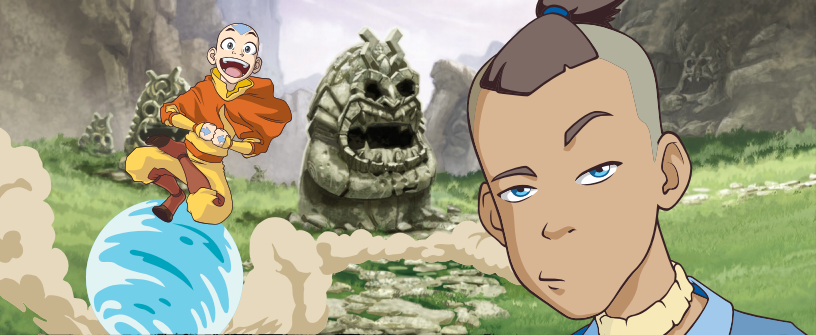
Aang propels himself at a ball of air past a statue of a beast with its mouth open in a mountainous setting. Sokka looks doubtful.
Magpie Games

Half the quickstart rules page count is taken up by the pre-written adventure "The Forbidden Scroll." The players are captured on the eve of Fire Lord Ozai's coronation but after being released by a defector, they must now escape the city before they are caught once more. It's a straightforward scenario with a range of options, many tailored to the pregenerated characters' backgrounds. It can be as quick or as drawn out as the table wants it to be, with a surprising amount of replayability.

Overall, it's a versatile little story with a few unique mechanics, like the clock tracking the festival events and the guards progress. If the rest of Magpie's Avatar output is on par with this, it's a very good sign.

The presentation of the quickstart rules is decent enough, though it's rife with misspellings. The rules, particularly Combat, are framed in a way that makes them seem more complicated than they actually are. Art wise, there's some great sheets for the actual game portions but the art consists of what looks like recycled promotional assets. And not very good ones at that.

There's still plenty left to explore in the final release, namely a proper NPC section, but Avatar Legends is a surprisingly complete publication, with an easy to learn system that authentically captures the setting.

Wednesday, February 10, 2021

Die Young - A MÖRK BORG Review


Mork Borg cover, the title taking up half the image in painted black letters. In front of the title is a skeleton with a rotting, bestial head, an upside down cross affixed to its forehad. It clutches a bloody sword in its right hand and a brone studded shield in the other.
Free League

 MÖRK BORG

Designed by Pelle Nilsson

Art by Johan Nohr

Published by Free League  

It can hardly get any worse for characters in Old School Renaissance darling MÖRK BORG. Humanity cowers in fear of the apocalyptic prophecies of two godly, twin-headed basilisks. The ever worsening state of this lightless, monster infested world makes it clear that doomsday really is just around the corner. Amid this unfolding nightmare, adventurers set out in the hopes of averting the end. Or just to plunder whatever's left to take. 

After all, the only kind of heroes in this world are the tragic, doomed kind.

MÖRK BORG, billed as a "pitch-black apocalyptic fantasy RPG," reads like the quintessential OSR game. Light on rules, heavy on the presentation, and reveling in the disgusting, it lays the genre's formula bare and picks through its guts. Luckily, MÖRK BORG takes all the best parts of the OSR movement and avoids its follies, for something truly one of a kind.

The renaissance art of wound man, a naked figure pierced with various melee weapons. Newly added pink text offers the name and stats of each one.
Free League
The book itself falls somewhere between an art zine and traditional RPG rulebook. Scratchy, depraved pieces and gloomy photos are paired with historical art. The latter is applied inventively, building both atmosphere and a grim sense of humor. The book uses both black and white spreads and splashes of color to equally good use. Despite what you'd expect, a large chunk of the book employs garish yellow and neon pink. 

I haven't had the pleasure to look through a physical copy but even through the unflattering medium of a PDF copy, MÖRK BORG is possibly the most visually impressive RPG book I've seen. If nothing else, it's certainly the most memorable, as it takes the grimdark staples of skulls, gothic castles, and satanic imagery to do something viscerally different.

My only criticism for the visual direction is that the PDF copy can prove difficult to read. The color palette and white text on black backgrounds might be important for the artistic vision but the readability suffers. The overall presentation might be the strongest part of the book, gothic and menacing, but it also poses some accessibility issues (sensory issues, screen readers, etc.) I acknowledge MÖRK BORG's current state is an important part of its overall feel but I think at the very least a more accessible, plain text version is necessary. I'd say that's a feasible ask in the age of PDFs.

Remember you are going to die

Beyond the artistic side of things, MÖRK BORG's thrives on its central dichotomy. The rules are clean and welcoming. The setting... isn't. It's a genius combination, one that prevents the game from becoming the mother of all "heartbreakers." MÖRK BORG jumps into the setting before anything else, though it favors short, evocative text over endless exposition. The game's doomed world quickly takes shape, alongside the gods, monsters, and royals presiding over the end. But much of MÖRK BORG is left shrouded in darkness, full of horrors just waiting to be concocted by game masters and confronted by the players.

A map of Mork Bork's setting, its borders represented by large cracks in the dark landmass, exposing the harsh yellow background. Various regions have names, with small sketches of mountains, graves and stranger growths reflecting their qualities.
Free League
The game is transparent about its influences: Berserk protagonist Guts' grisly origins and Warhammer Fantasy Roleplay's iconic "Small but Vicious Dog" make appearances. Even its fatalism feels familiar in some way. Perhaps it's because the lack of a true "general audience" to placate, but tabletop games have a storied history of utterly hopeless worlds. Even with such apparent inspirations, I've never seen anything quite like MÖRK BORG. Focusing on building such a strong atmosphere over setting minutiae contributes to that. You get a strong sense of the world from passages that often barely makes sense, really selling the idea you've found the last holy text of a doomed culture.

MÖRK BORG goes completely over the top, to the point of satire. It's a resoundingly bleak setting in a way every newly minted edgelord player can only dream of. Surprisingly, it's said there is a way to save the world. They just decline to say how. With horror at every turn, it's not clear where players are supposed to look for salvation. 

The game certainly pushes the boundaries of taste with the gratuitous violence. Adventuring "rewards" often come in the form of severed body parts and miscasts include lethal magical STDs. The almost cartoonish heavy metal nature loops back around to one of the best dark comedies ever to grace the medium.

It helps that MÖRK BORG avoids anything truly discriminatory, even if it delights in being grotesque. White Wolf and even my beloved Warhammer have decades of genuinely offensive blunders. The worst I'd accuse this game of being is overly crass and perhaps juvenile.

Dog Eat Dog

In the vein of most OSR games, MÖRK BORG saves the heavy stuff for the setting. Built (perhaps literally) from classic Dungeons & Dragons' bones, most dice rolls are made with D20s. Tests are determined by trying to roll at or above the Difficulty Rating, with positive or negative modifiers from the relevant Ability. There's only four to keep track of: Agility, Presence, Strength, and Toughness.

A queen gleefully clutches a bearded knights' severed head. His corpse is still kneeling, as if in prayer, black tendrils extending from the stump that was once his neck. The background is a mixture of white and harsh yellow, depicting a castle.
Free League
This game uses a lot of different dice, ranging from the ubiquitous D6 to the rare D2. Between calculating damage, armor defenses, and the more unique mechanics, you end up rolling a lot more than just D20s. Even so, the core mechanics are dead simple, though the players end up doing almost all the dice rolling. In combat, they roll their character's attacks and then against Agility to see if they dodge their adversaries' blows. 

Combat is as messy and quick as you'd expect. The only defenses come from largely brittle armor and Omens, a small, replenishing pool of points spent to negate enemy damage or maximize your own. Hit zero wounds and you roll on the unforgiving Broken chart. Blow past that and it's all over.

As a "perma-GM" I'm hugely in support of it, though perhaps a little biased.Though it's far from demanding, having players do the little work combat requires lets the GM focus entirely on writing the scenario and building up the setting's mood. 

The Hand of Fate

Rather appropriately for MÖRK BORG's emphasis on "cruel fate," there are random charts galore. This ranges from core game mechanics, like the perfidious scroll based magic system, to the purely cosmetic, like the weather chart. There's a chart for just about everything, and even if many of them are optional it adds a strong vein of spontaneity to the game. Even character creation is almost entirely random, including how you pick from the six optional classes. The game's website even sports a random character generator, SCVMBIRTHER, which is immensely useful for one shots. 

In large jagged letters reads BELZE, with the english translation "blood-drenched skeleton" next to it smaller, normal black text. The stats are below it. 3/4 of the page is taken up by a screaming skeleton, a raw, fleshy red aside from its jagged white teeth. Visible from the shoulders up, blood splatters obscure the yellow background.
Free League
 The adventures seeds and dungeons themselves can be randomly generated too. And luckily, there's scarcely an uninteresting result. 

On the less random side is the short but memorable bestiary. It's mostly common fantasy staples, though with a strong Swedish mythology and heavy metal bent to it. There's a strong emphasis on increasingly vile kinds of undead, with some very novel takes and mechanics on classic creatures. Curse based goblins visually modeled off of goblin sharks took the cake for me.

Here Comes Doomsday

Even amid a sea of random charts, MÖRK BORG's most unique and crucial rule still has an overwhelming presence. At the start of each in game day the game master rolls a die, the specific one depending on how long they want the world to last. On a 1, you roll a D66 and consult the Calendar of Nechrubel, a set of 36 Miseries divided into Psalms. Each one is a short "Revelations" style tale of the apocalypse.

When the Seventh Misery is rolled, the game and its world come to a crashing halt, as it finally ends.

An unthinkable mechanic in just about any other game and perfect for MÖRK BORG. Plenty of RPG settings have a looming apocalypse but I can't think of any where that impacts the actual gameplay in such a material way. Here, the world deteriorates around the players at the whim of the dice, until the bough breaks.

A black field, with the silver image of a skull with an hourglass perched atop it, a snake curled around its jawless teeth. Beneath it, in reflective silver letters it reads "The Calendar of Nechrubel." Beneath that in smaller font reads: "The world trembles. One can feel it in ways sharp and subtle, mysterious and clear. One by one, inevitable events demand their place."
Free League
Like the rest of MÖRK BORG, the specifics of each misery are left open to interpretation. Each of the six psalms have a clear storyline and progression but it's statistically improbable for every Misery to come from the same Psalm. It's even less likely to roll them in the "correct" order.

What you're left with is an apocalypse out of sequence, lacking even the comfort of a coherent timeline. With each Misery being a short cryptic sentence, GMs are given considerable leeway in interpreting them. It's an evocative system that makes the end of the world a tangible part of every MÖRK BORG game, without reducing it to a dull, purely mechanical affair.

Go Forth

MÖRK BORG is the sort of game that can get away with offering what's essentially the bare minimum. The game might not be a 400 page tome but there's more than enough to bring out whatever life remains in the final days. And the tradeoff of quality over quantity hardly means its unsupported. The games' official website has a huge offering of free material, including adventures, dungeons, classes, and a bestiary.

Entirely in black and white, a low angle shot of a robed figure with a monstrous visage. Two ox like horns spring from its temples, with two smaller ones next to each. It has stranged ridged rods covering much of the face, with small discs with runes scrawled on them. A row of dagger like teeth sprouts below it. Its unclear if it is a mask or not. Strands of hair spill from the hood. Rain lashes down around them, wwith a dead trees sprouting from both corners.
Free League

As for MÖRK BORG itself, it's a game I strongly recommend to just about anyone into RPGs. But not as your first game.
MÖRK BORG doesn't just expect you to handle its more graphic content, as there's a clear assumption that you know your way around a game system. The broad rules and setting might offer a lot of agency but by the same merit it doesn't offer much guidance. 

Overall, it's a harsh world GMs and players are left to navigate but one that's worth every painful step of the way. Even if their journey is cut abruptly short...


Saturday, January 23, 2021

They're Trying to Build a Prison - A Durance Review


Bully Pulpit Games (Jesse Parrott)
 

Durance thrusts player into a deep space prison colony on a hostile, barely understood world. They'll assume roles on both sides of the colony's power structure: its criminal populace and their rulers. Resources are scare, death is plentiful, and power regularly trades hands. An individual can rise through the ranks, but who's to say anything will be left to reign over. And who knows what they'll have to give up along the way...

Published by Bully Pulpit Games a few years after their hit roleplaying game Fiasco, 2012's Durance was also written by Jason Morningstar. Like its predecessor, Durance is a part of the new breed of "Rules Light Story Games," where complex mechanics and hours of prep are discarded for a wholly narrative experience. Rather appropriately for a game about hierarchy- and the way it changes - Durance has no Game Master. The closest it gets are the Host and Guides, the former who mostly just sets things up. 

Players take turns as the Guide, passing off control clockwise each scene. They set up the scenario with a single question, which can be vague or specific - as long as it generates some conflict between two characters. The Host merely asks the occasional question to keep things on track.

With a setup like that, Durance gets as chaotic as you'd imagine. With no real GM and little in the way of rules, the only thing holding the show together are the shifting authorities of the prison colony. Durance relies almost entirely on improvisation and the good will of the players, leading to some of the more memorable sessions I've played. The focus on story and way it puts you on the spot also helps players get used to RPGs as a story rather than some sort of analog video game. Overall, it's more fun than you'd expect to have on a hostile world with no hope of escape.

No Such Thing as Paradise

In contrast with the almost nonexistent rules, Durance leans heavily into the atmosphere created by its setting. A spacefaring humanity struggles with the same old problems, taking the "humane" route with their excess criminals and ne'er-do-wells. Hurled across space to settle barely explored worlds, never to return. There's even the promise of freedom, though only the convicts' children will likely get to enjoy it. Unfortunately, out of an overenthusiasm or sheer apathy on the part of surveyors, the prison colonies are hardly being established on paradise worlds.

Handwritten text surrounds a drawn headshot of a grinning man with unkempt curly hair, in a jacket with handkerchief. he smiles mischievously. In the lefthand corner is a circle emblem with a dot in the center.
Bully Pulpit Games (Brennen Reece)

The characters, free and imprisoned alike, discover their promised fresh start is on a vicious, hostile world. That's hardly the circumstances for a more just, freer society and no one feels like playing nice. Injustice reigns across the newly settled stars and even authoritarian rulers and back breaking labor has failed to stamp out criminal empires. There's little cause for hope but that hasn't stopped a few from wanting it all.

Durance offers a setting with some clear rules and history but plenty of room for improv heavy roleplay. As much as I love my elaborate, interconnected game settings, that doesn't make broader but no less compelling settings any less appealing. The gameplay integration certainly helps that and leads to the most enjoyable mechanic. Kicking off every game is the Planetary Survey, a set of six facts about the planet's habitability. Players go around in a circle striking off a fact each, until only three of the ideal qualities are left. 

The remaining facts match up with one of 19 pregenerated planets, with suitable names like "RFS 617" and "Amur's Folly." Players compare the world's pollyannic report with the harsh reality of the situation, along with 6 Details, story prompts to be used by the Guides when forming their questions.

The process is repeated for Colonial Records, generating an equally unappealing regime for the players to endure and/or profit from. In addition to another 6 Details, players are given the Authority's perspective on the colony, alongside the Convict's experience. As you could imagine, it hasn't been working out for either of them.

The numerous options add to the replayability, while selling the background and tone of the game better than winding paragraphs could. Players see what the colonists were sold was not the hardscrabble, industrial nightmare they received. It's an evocative text that immediately sets the stage, giving some very important guidance in a game where players are left largely to their own devices. 

I am the Law

Each player receives two "Notables," one Convict and one Authority. Multiple characters are very uncommon, even for more unorthodox RPGs but a stroke of genius for Durance. As the book notes, it helps to have a backup when death looms so large. It also keeps players involved in the colony's constantly evolving story, which would otherwise be difficult without a traditional GM to keep the focus even. Most of all, having a character on both sides of the ladder lets players experience the full range of the colony's repressive social order, with the added bonus of keeping real world antagonism in check.

A white clad figure in a cave, etrance by a device as he's illuminated by a tablet looking device. Tools are around the sitting figure, who is happily oblivious to the two armed silhouettes approaching from behind.
Bully Pulpit Games (Jesse Parrott)
Each character has a different position on a five step Ladder. The Authority Ladder is topped by the Governor, with Empancipists, freed convicts, on the bottom. Meanwhile the Convict Ladder is helmed by the deceptively named Dimber Damber, the Governor;s parallel in the underworld. It's rather appropriate that where a former Convict is the lowest you can get on Authority, the bottom of Convict is filled by Crawlers, the desperate and unloved on the brink of death.

In between that are the lieutenants, muscle, schemers, and comparatively normal folk. There's a range of roles to be filled, though the lack of any real heroes definitely stands out. Players can certainly choose to do the right thing but circumstances discourage it. Every Notable seeks the colony's unique Drive, chosen from six by process of elimination. Encompassing broad ideals like Control, Harmony and Freedom, every Notable has to balance their desire for the Drive with their Oaths, generated on a chart and fleshed out by the players.

Uncertain Times

When an Oath is broken, the change affects far more than just the Notable (who promptly fades into the background, potentially in lethal ways). A position on the Ladder shifts, part of the assessment changes, or the Drive even switches over. Character development plays a big role in Durance and a single person's decision can affect everyone.

Another journal entry. Two silhouettes stand at the base of a flat topped obelisk many times their size, with strange sickle like emblems on the highest part of each visible side. Separated by jorunal text is the headshot of a despairing bold man with a full beard.
Bully Pulpit Games (Brennen Reece)
After that, the only real "rule" left is the Uncertainty Triangle. Composed of three categories, Servility, Savagery, and the Unique Drive, each has a dice assigned to them. When a scene hits an impasse, usually because a Notable refuses to break their Oath, two of the dice are rolled. The triangle functions pretty simply. Going clockwise, the Drive higher than the next wins out, to be interpreted by the players, with the Guide settling any disagreements. Doubles and Triples prompt a roll on a random chart of important, potentially cataclysmic events.

Aside from that, there's hardly any dice rolling involved in actually playing Durance.

All the Rest

Despite the light ruleset, most of Durance's 133 page count is taken up by the mechanics, mainly the different planets and colonies. Much like the setting, there's no room for waste here. The game's lack of complexity hardly means a lack of thought was put to it. The many worlds of Durance feel fleshed out, a must for a game so open to interpretation. Evocative art from Brennen Reece and Jesse Parrotti further sells that. It's raw and sketchy, taking the form of journal illustrations, though the sense of humanity isn't lost in the rough. The same goes for the more detailed color pieces, which feel no less desperate - or sympathetic.

The book also briefly offers support for using Durance to roleplay its historical inspiration; 18th century Australia, recently colonized by the First Fleet. The parallels are apparent if uncomfortable in places. Playing space colonists obviously lacks the same historical weight as real world settlers. The author even concedes that's in poor taste to have aboriginal people slotted into the role of "hostile aliens." The offered defense, that the two groups might as well have been worlds apart, doesn't really justify it either. The real world also has far less room for improv, as reflected by the substantial Resources list of nonfiction books and wikipedia articles. 

It does draw attention to one of the few real issues with Durance. Between the chaos of the game itself and the difficulty most players have with improv, it's not very sustainable. Things tend to go in a very disastrous very quickly. That's perfect for one shots but largely unsuitable for long term play, which you'd especially hope for after putting in the work for a historical game. Even then, you could argue that adds to the already strong level of immersion. Nothing was built to last in the prison colonies of Durance, so it's up to the players to make their mark before their time is up.